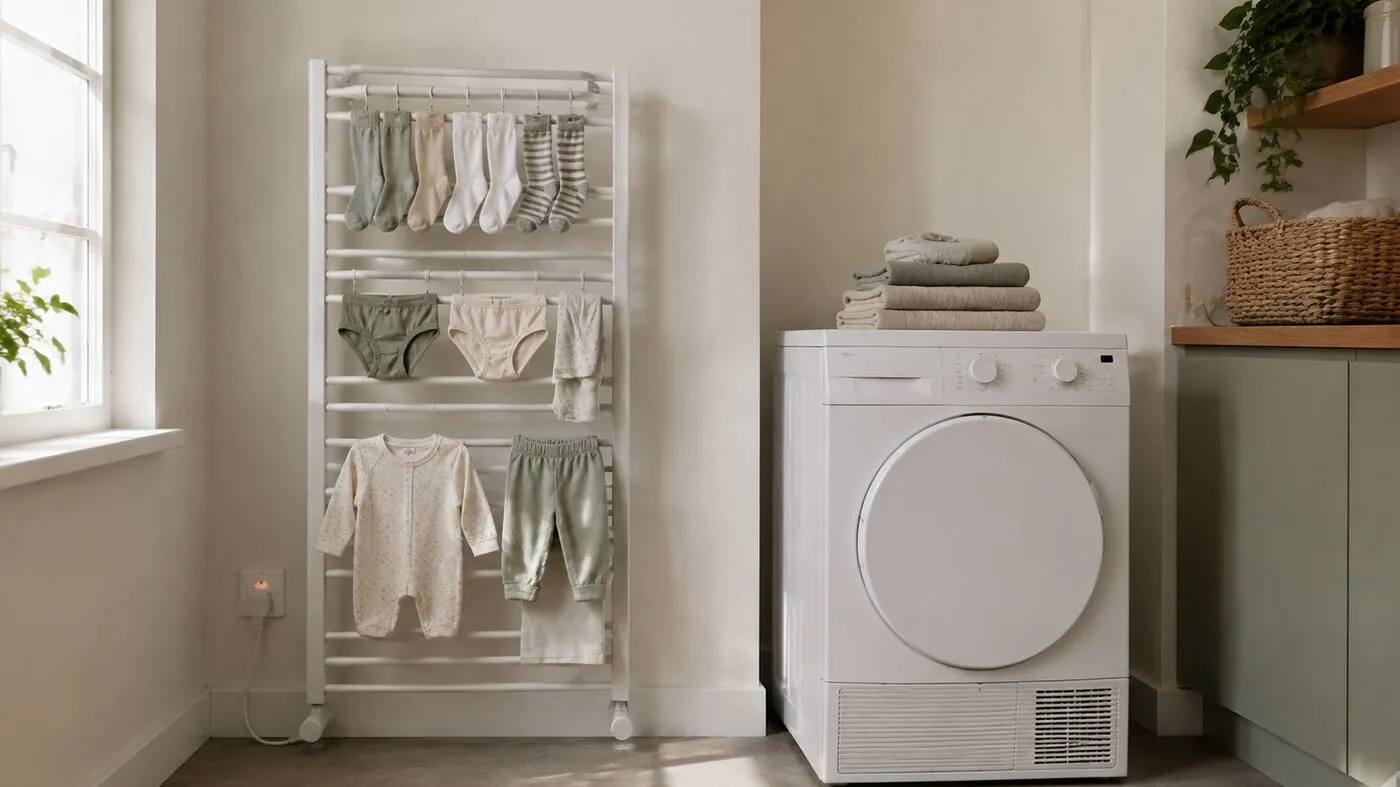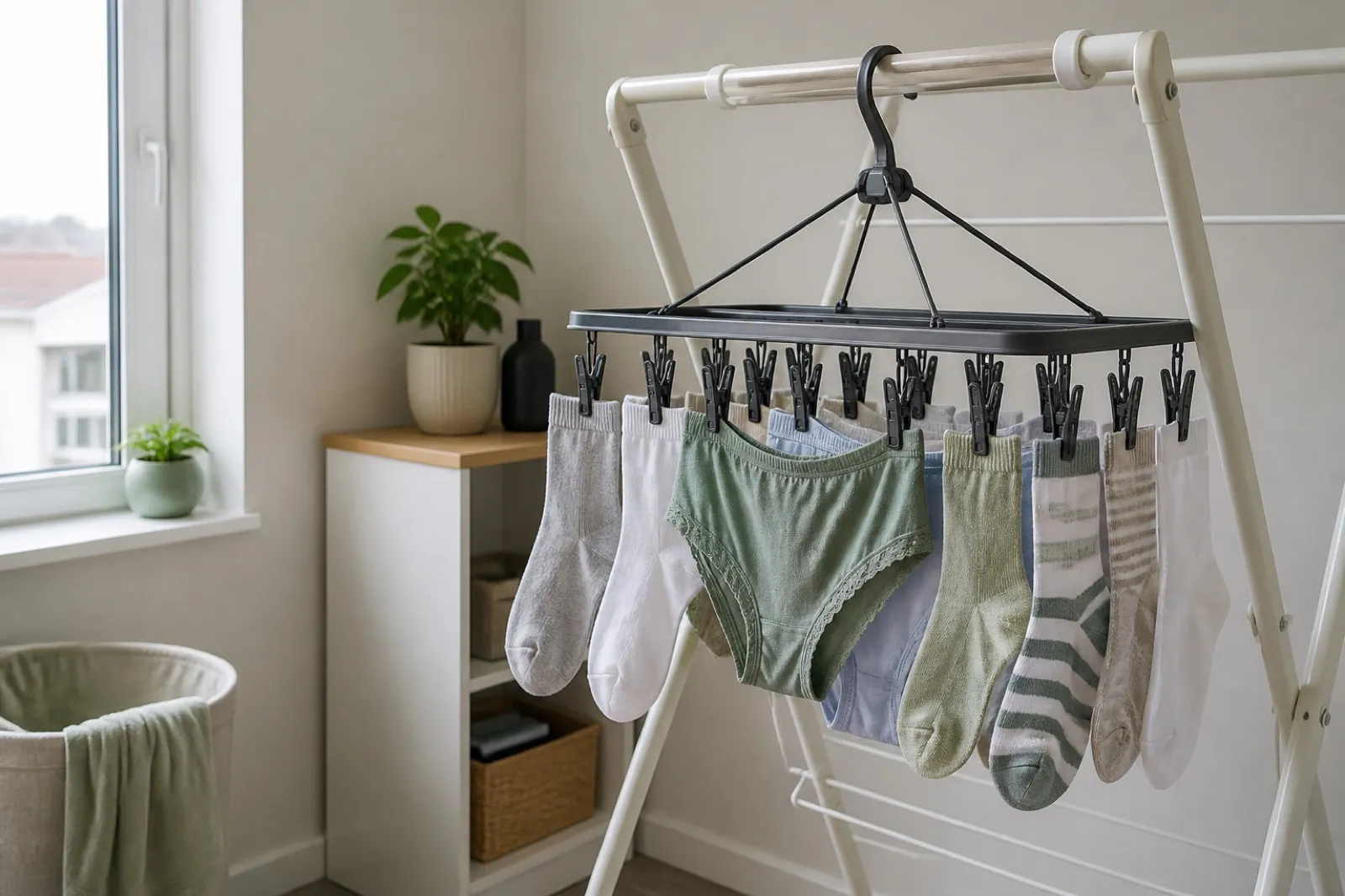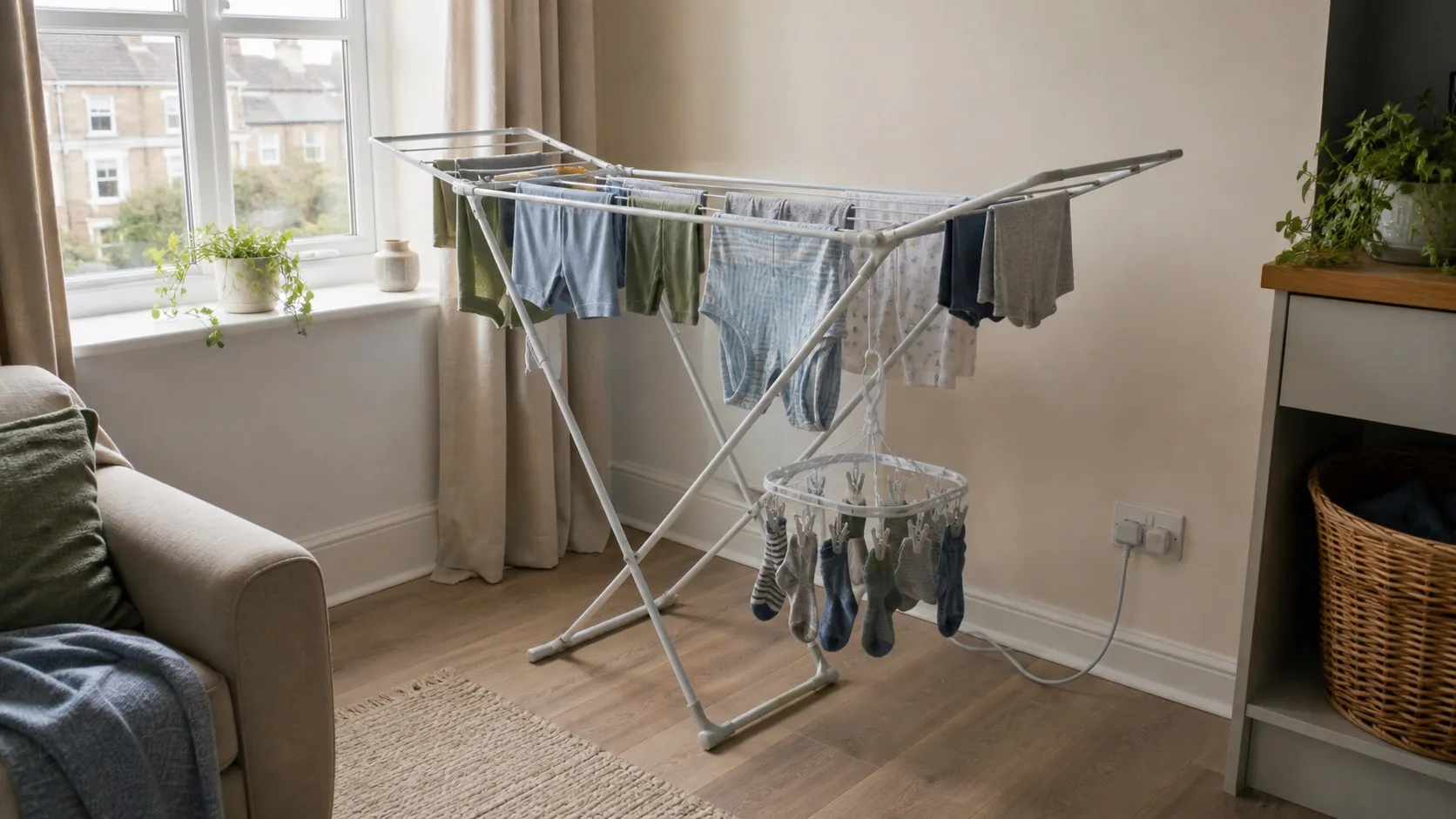
A sock drying hanger is one of the simplest ways to make a small airer work harder. It gathers socks, underwear, baby clothes and other small garments into unused vertical space, leaving the rails free for larger items. An ordinary hanger has no heater or motor, so it costs nothing in electricity to run on its own.
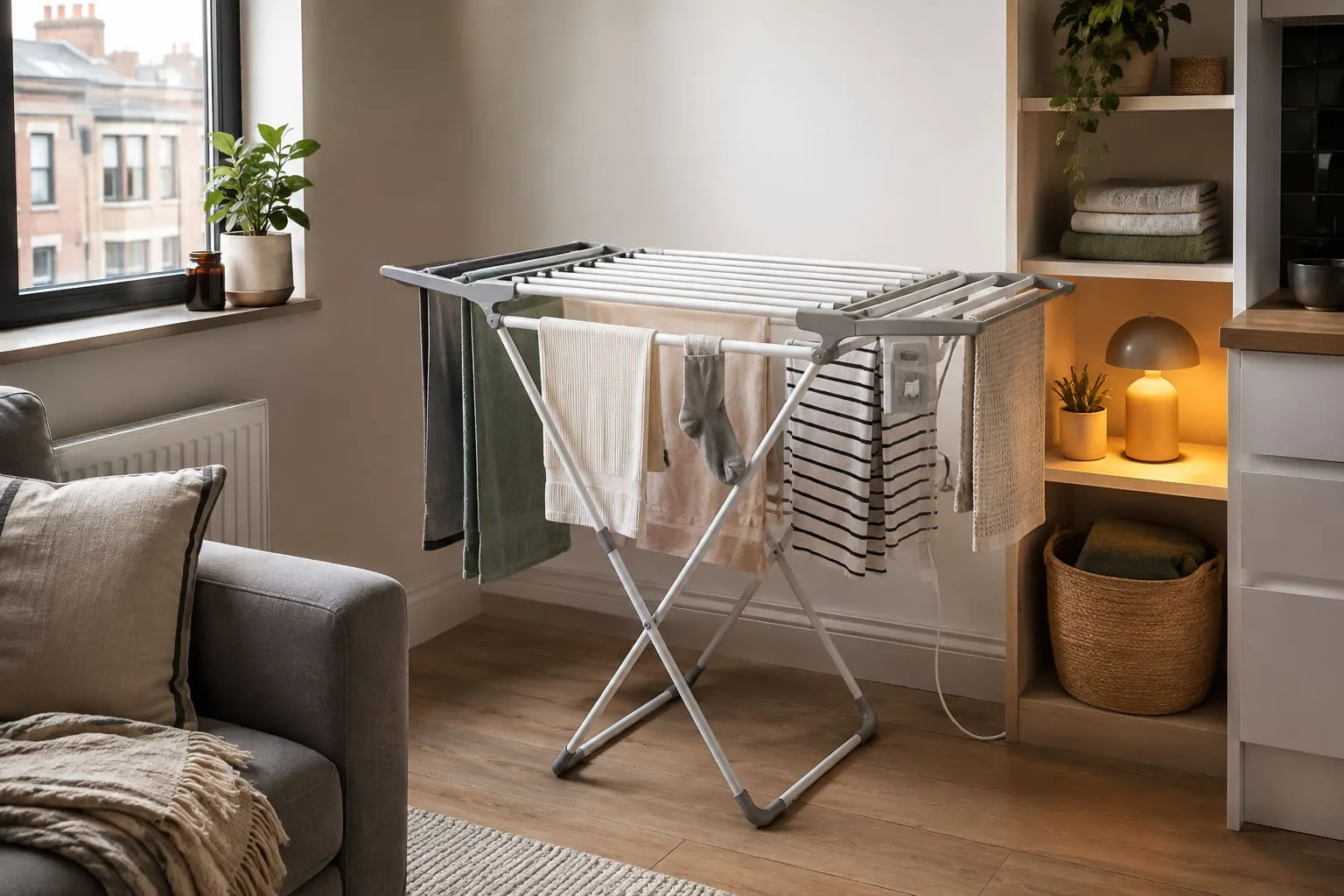
The cost begins when you pair it with a powered heated airer. At the current Great Britain price-cap average of 26.11p per kilowatt-hour (kWh), a rail-style airer rated at 300 watts costs about 7.8p per hour. Four hours would use 1.2kWh and cost about 31p. Your actual figure depends on the wattage printed on the appliance and the unit rate on your energy bill.
This guide shows how to calculate that cost without assuming a particular product or promising a fixed drying time.
Sock drying hanger costs: unheated versus heated
The phrase “sock drying hanger” can describe two different arrangements, and the distinction matters for your bill.
- An unheated hanging frame: this is a small frame with pegs, clips or flexible grips. It hangs from a washing line, shower rail or clothes airer and uses no electricity.
- A hanger used with a heated airer: the hanger still uses no power, but the airer beneath or around it does. It may help organise the load, although it does not change the airer’s rated wattage.
- A powered heated drying device: some compact drying units have their own heating element or fan. Treat these as electrical appliances and calculate their cost from their own rating label.
If you only need more hanging space for small items, read our guide to sock and underwear drying hangers. For a powered rack that can take the rest of the wash, see the overview of heated airers for small flats.
How to calculate a heated airer’s running cost
You need three numbers:
- The appliance’s power rating in watts, shown on its rating label or in its manual.
- Your electricity unit rate in pence per kWh, shown on your bill or tariff information.
- The number of hours the airer is switched on.
Convert watts to kilowatts by dividing by 1,000, then use:
Cost in pence = power in kW × hours used × electricity rate in pence per kWh
For a 300W airer running for four hours at 26.11p/kWh:
0.3kW × 4 hours × 26.11p = 31.33p
The 26.11p figure is Ofgem’s average single-rate electricity price for a Direct Debit customer covered by the price cap in England, Scotland or Wales from 1 July to 30 September 2026. It is a useful worked-example rate, not a universal UK tariff. Your rate can differ by region, payment method, tariff and meter. Northern Ireland has a separate energy market, so readers there should use the unit price shown by their supplier.
You do not normally add the daily standing charge when comparing the extra cost of an airer session. That charge is payable for having the electricity supply available, regardless of whether the airer is used that day.
Heated airer cost per hour at 26.11p/kWh
The table below shows energy cost only. It assumes that the appliance draws its full stated power continuously; thermostatic controls or cycling may make measured consumption different.
| Rated power | Cost per hour | Cost for 4 hours | Cost for 8 hours |
|---|---|---|---|
| 100W | 2.6p | 10.4p | 20.9p |
| 200W | 5.2p | 20.9p | 41.8p |
| 300W | 7.8p | 31.3p | 62.7p |
| 1,000W | 26.1p | £1.04 | £2.09 |
These rows are examples, not categories every model will fit. Electrical Safety First says heated-wire airers tend to be around 250–330W, while heated-air “pod” designs can use considerably more power. Two appliances both marketed as heated airers may therefore have very different hourly costs.
Check the label rather than relying on the product’s shape, size or marketing name.
What affects the cost of drying one load?
Hourly cost is only half the calculation. The cost per load also depends on how long you keep the appliance running, and that varies with the clothes and the room.
The washing machine’s spin cycle
Water removed in the washing machine does not have to evaporate indoors. Use the highest spin speed that is suitable for the fabric and care label. A separate spin after the wash may leave less water for the airer to deal with, although it also uses some electricity.
Garment thickness and arrangement
Thin socks and baby clothes generally contain less water than jeans, towels and thick waistbands, but a tightly packed load restricts airflow. Spread items out, open pockets and avoid folding several damp layers over one rail.
A sock hanger can free heated rails for larger clothes. Keep gaps between the small items rather than filling every clip if the garments overlap.
Contact with heated rails
Rail-style airers deliver the most direct heat where fabric touches or sits close to the warm bars. Thick parts may need repositioning for more even drying. A suspended sock hanger may benefit from warm air rising around it, but it is not the same as putting every item in contact with a heated rail.
Room temperature, humidity and airflow
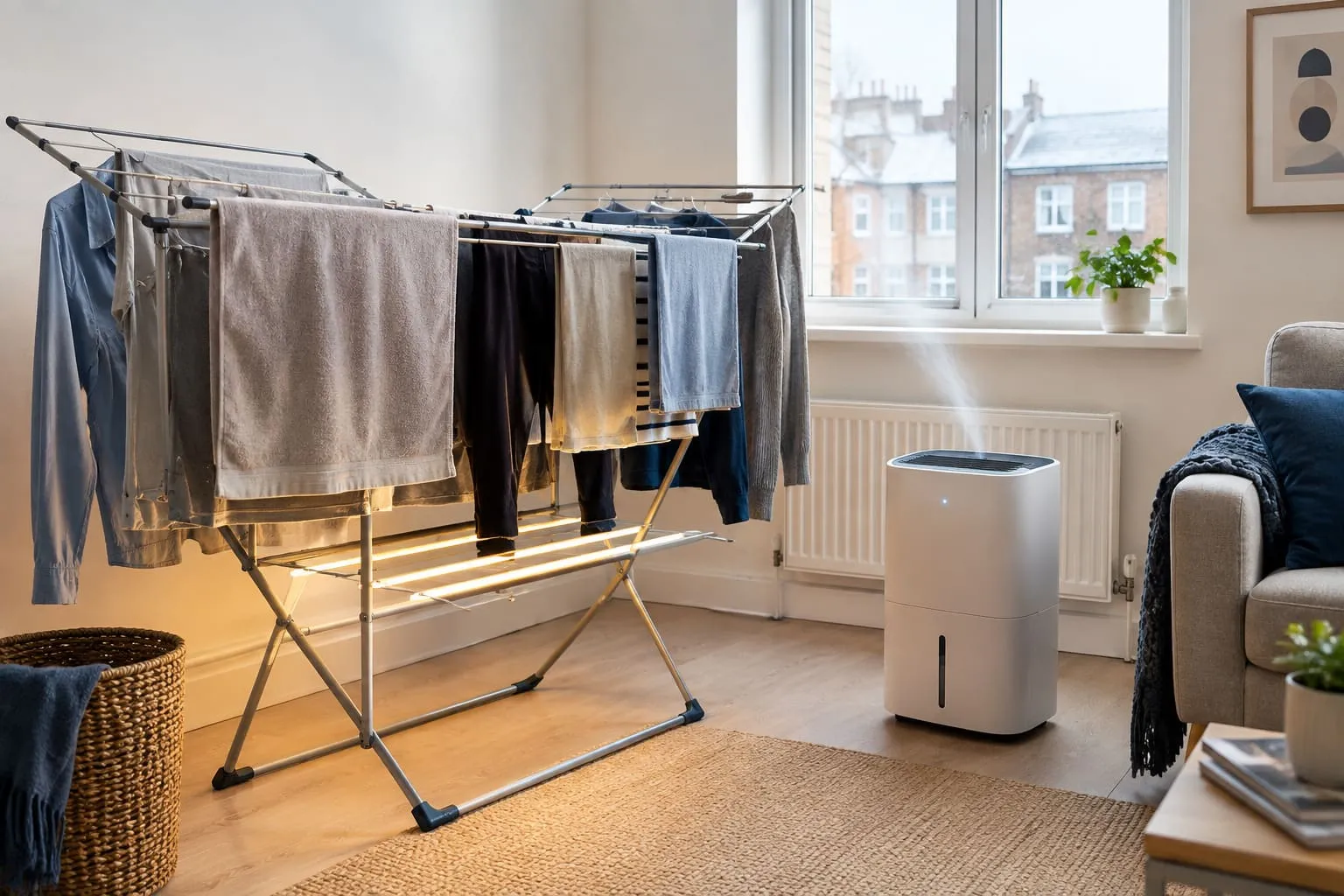
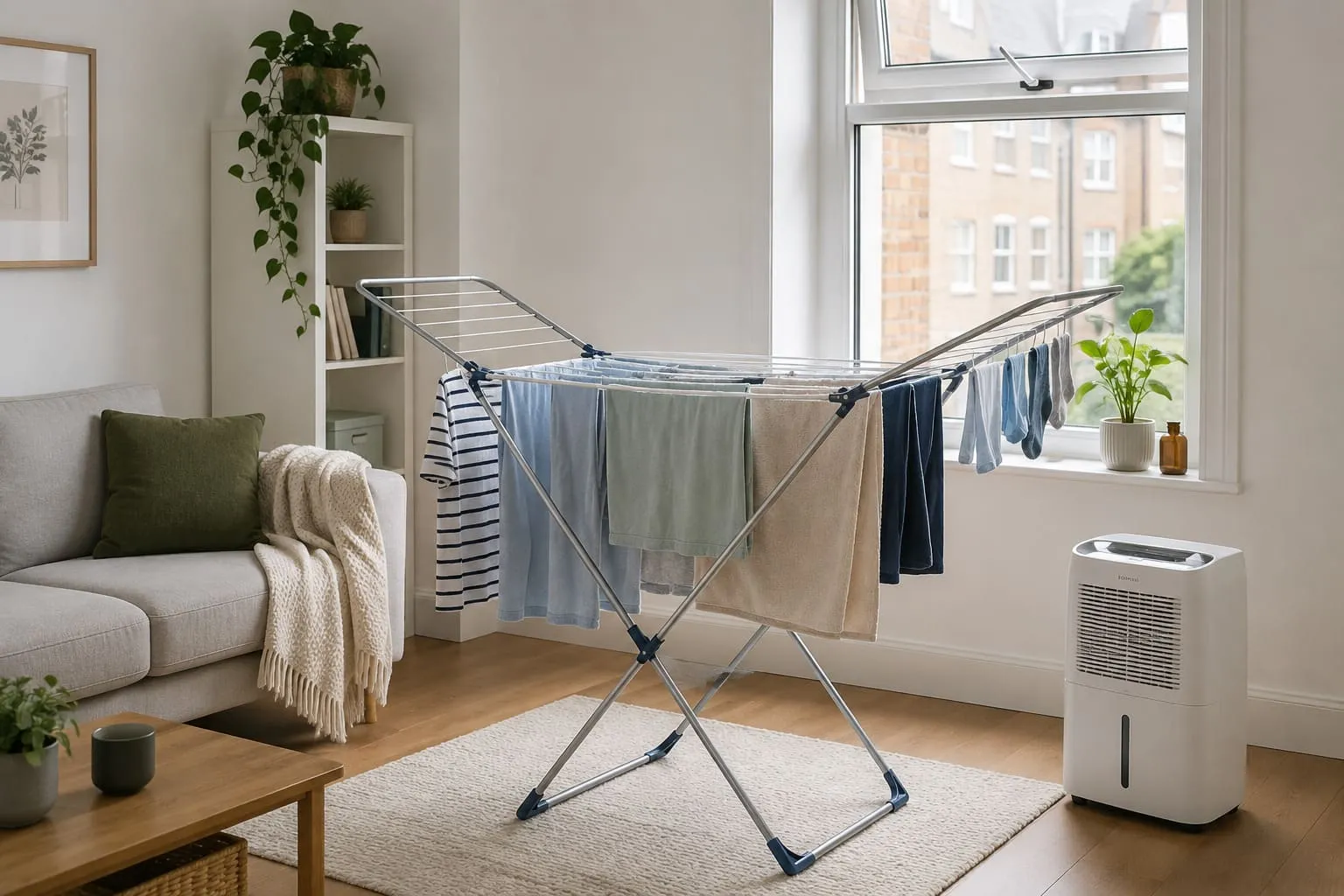
Drying slows as the surrounding air becomes more humid. A heated airer helps moisture leave the fabric, but it does not remove that moisture from the home. Use safe ventilation, such as an open window and a closed internal door, or a suitable dehumidifier setup when outside air is not practical.
If condensation is already appearing, compare a heated airer and dehumidifier and read our guide to drying clothes in a flat without a tumble dryer.
Covers and timers
A compatible cover is passive, so it does not add a separate electricity draw. By keeping warmer air around the load, it may alter the time needed, but the outcome depends on the airer, cover, room and arrangement of clothes. Use only a cover approved or specified for the appliance and do not block controls or ventilation openings.
A timer can prevent an appliance running longer than intended. Use a built-in timer where provided or a suitable plug-in control only if the airer manufacturer allows it.
How to keep running costs under control in a small flat
Start by measuring rather than guessing. A plug-in energy monitor can show the kWh used during a real session; multiplying that reading by your tariff gives a better household figure than assuming the rated wattage was drawn throughout.
You can also reduce unnecessary running time by:
- spinning the load well before hanging it;
- giving each garment space for air to move around it;
- using a sock drying hanger to release rails for bulkier items;
- grouping laundry in one suitable room rather than adding moisture throughout the flat;
- switching the airer off when the load is dry; and
- checking your electricity unit rate whenever your tariff changes.
Do not chase a lower electricity figure by drying laundry in a sealed, increasingly humid room. If moisture collects on windows or walls, ventilation or dehumidification is part of the drying setup, not an optional extra. Our guide to stopping condensation in a UK flat explains the warning signs and practical controls.
Using a sock hanger safely with a heated airer
Not every heated airer is designed to carry an additional hanging frame. Check the manufacturer’s maximum load, assembly instructions and permitted accessories before attaching one.
Keep the sock hanger balanced and make sure it cannot pull the airer over. Do not let wet garments touch the plug, socket, control unit or cable. Keep the cable where it will not become a trip hazard, and stop using the appliance if you notice damage, scorching, unusual heat, crackling or a burning smell.
Where an extension lead is unavoidable, Electrical Safety First advises against overloading it or plugging one extension into another. A wound cable reel can also overheat, so it must be fully unwound and used within its marked rating.
Follow the airer manufacturer’s instructions on covers, clearances and unattended use. A low power rating does not remove the need for normal electrical safety.
The bottom line
An ordinary sock drying hanger costs 0p per hour because it is only a space-saving accessory. When it is used with a heated airer, calculate the powered appliance separately.
At 26.11p/kWh, a 300W heated airer costs about 7.8p per hour, while a 1,000W heated drying pod costs about 26.1p per hour if it draws its full rating. The most accurate answer for your home is always:
your appliance’s kW rating × hours used × your tariff’s unit rate.