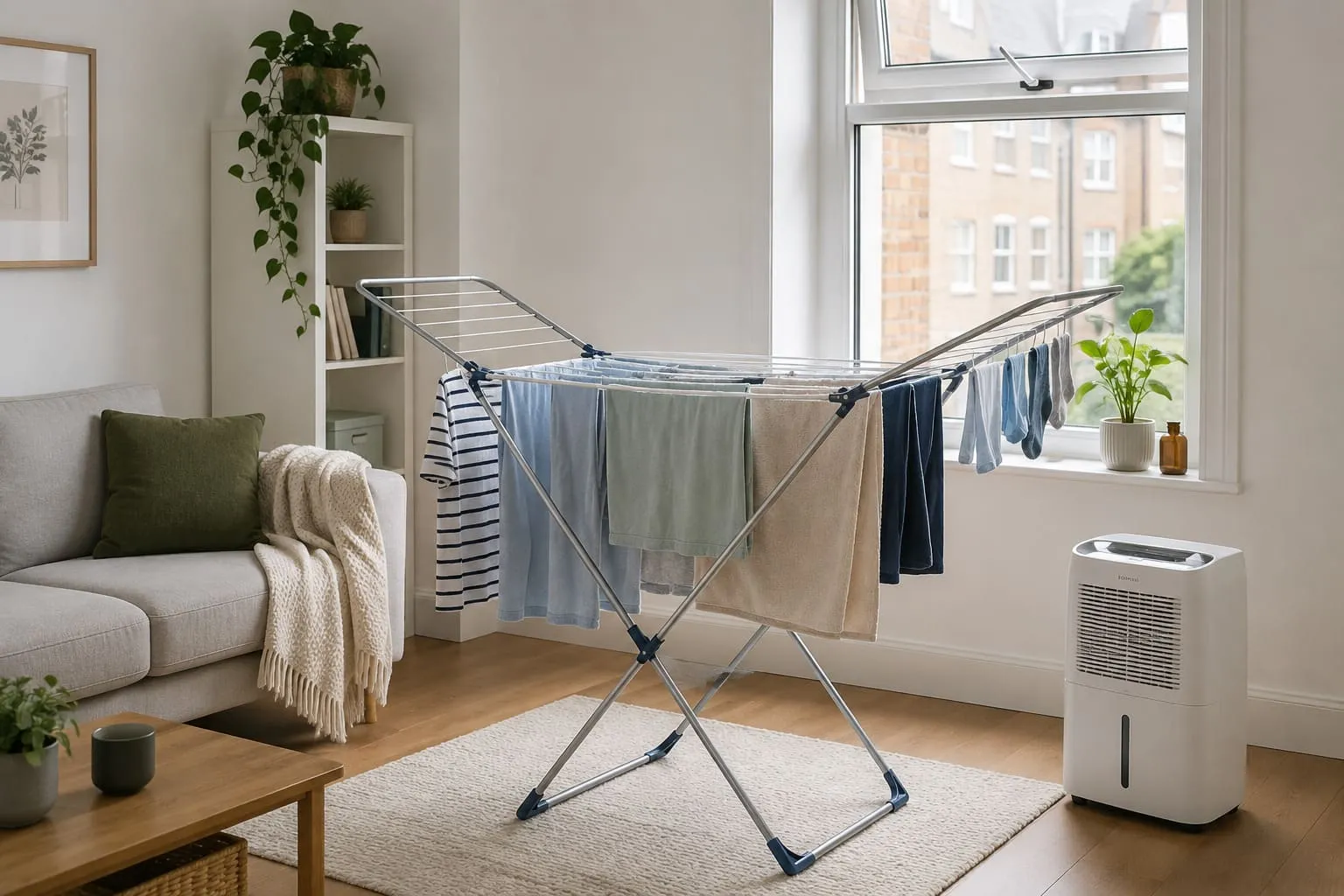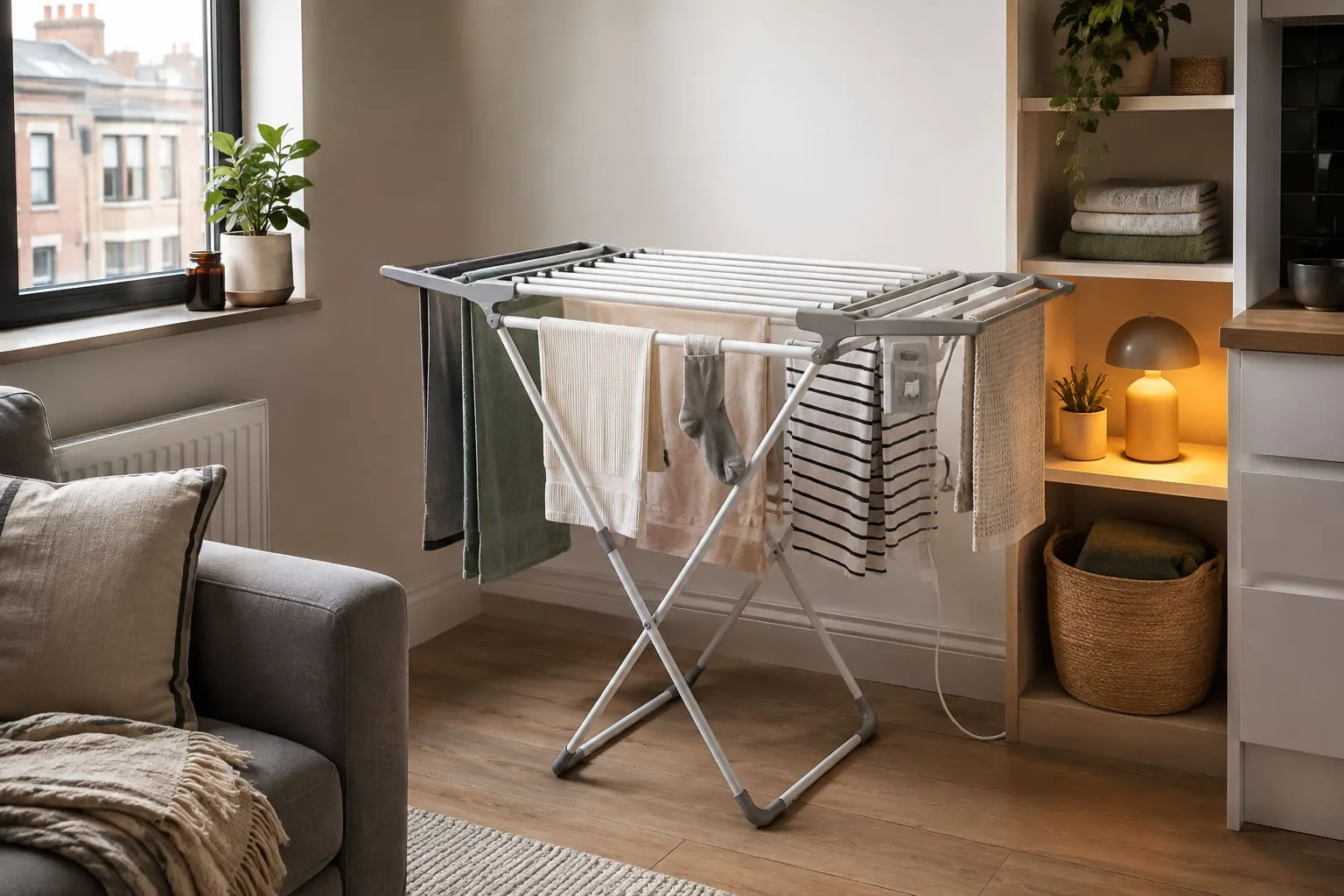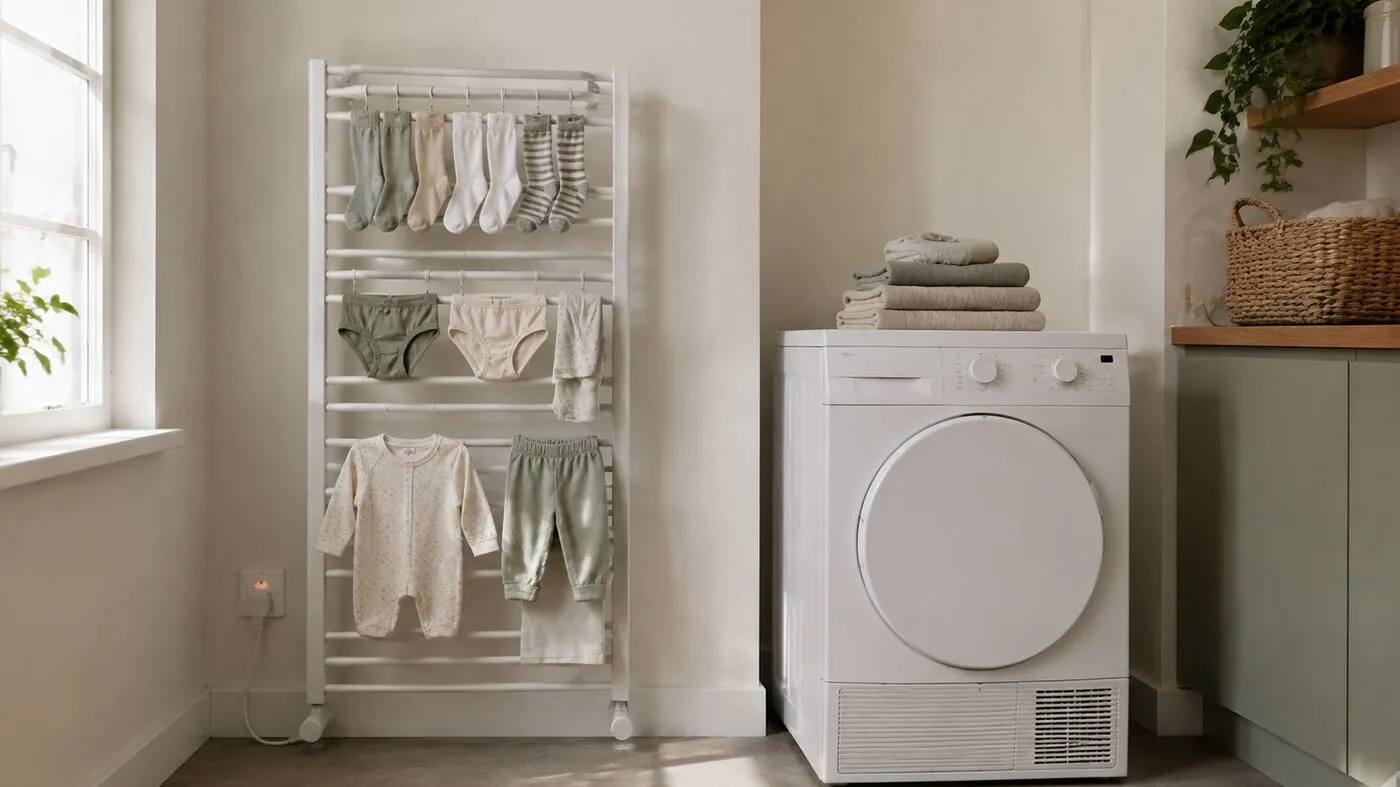
Comparing a heated airer vs tumble dryer is not as simple as looking at the wattage on each appliance. A heated airer normally uses far less electricity per hour, but it may stay on for many hours. A tumble dryer draws more power while running, yet completes a defined cycle and may therefore be closer in total cost than the hourly figures suggest.
The fairest comparison is energy used for the whole drying session, measured in kilowatt-hours (kWh). This guide shows how to calculate it using your own tariff and appliance information, with no assumption that every load or home dries at the same speed.
Heated airer vs tumble dryer: the short comparison
| Factor | Heated airer | Tumble dryer |
|---|---|---|
| Typical energy information | Power rating in watts | Energy label or product sheet in kWh per cycle or per 100 cycles |
| Hourly electricity use | Usually low for a heated-wire model | Higher while the heater, drum and fan are operating |
| Session length | Often several hours; highly dependent on the room and load | A defined programme whose duration varies by model, load and sensor readings |
| Space in a small flat | Takes floor space while open, but many models fold | Needs permanent floor space and suitable installation |
| Moisture | Releases water from clothes into the room | Collects or vents moisture, depending on dryer type |
| Small garments | Easy to arrange and remove individually | Convenient for suitable items in one batch |
| Fabric care | Gentle drying, although heat-sensitive items still need care | Not every garment is tumble-dryer safe |
In most cases, the heated airer wins on cost per hour. The winner on cost per load depends on how long the airer runs and how much energy the tumble dryer uses for its chosen cycle.
How much does a heated airer cost to run?
Electrical Safety First says heated-wire clothes airers tend to be rated at about 250–330 watts (W). That is 0.25–0.33 kilowatts (kW).
At Ofgem’s current Great Britain price-cap average of 26.11p per kWh for a Direct Debit customer from 1 July to 30 September 2026, the calculation is:
hourly cost = power in kW × electricity unit rate
| Heated-airer rating | Electricity used per hour | Cost per hour at 26.11p/kWh |
|---|---|---|
| 250W | 0.25kWh | 6.5p |
| 300W | 0.30kWh | 7.8p |
| 330W | 0.33kWh | 8.6p |
These are full-power examples. A thermostat or timer may change actual consumption. The Ofgem rate is also an average for England, Scotland and Wales, not a universal UK price. Fixed tariffs, regional rates, payment methods and Northern Ireland tariffs can differ, so use the unit rate on your own bill.
To estimate a whole session, multiply the hourly figure by the number of hours the airer is actually switched on. For example, a 300W airer uses 1.8kWh over six hours, which would cost about 47p at 26.11p/kWh. Six hours is a calculation example, not a drying-time promise.
For more wattages and a reusable formula, see how much a heated airer costs to run.
How much does a tumble dryer cost per cycle?
Tumble dryers differ substantially. Heat-pump models reuse heat and are generally more efficient than conventional condenser or vented machines, but the model, programme, load size, moisture level and maintenance all affect consumption.
The most useful figure is on the appliance’s energy label or product information sheet. Depending on the label in use, you may see annual energy consumption or energy consumption per 100 drying cycles. Follow the stated assumptions rather than comparing unrelated figures.
Where the label gives kWh per 100 cycles:
energy per cycle = label kWh per 100 cycles ÷ 100
cycle cost = energy per cycle × your unit rate
Here are two deliberately generic examples at 26.11p/kWh:
| Energy-label figure | Energy per cycle | Illustrative cycle cost |
|---|---|---|
| 150kWh per 100 cycles | 1.5kWh | 39p |
| 300kWh per 100 cycles | 3.0kWh | 78p |
These figures demonstrate the maths; they do not describe every heat-pump or condenser dryer. Your machine’s label and your selected programme are the relevant evidence.
Do not add the daily standing charge when comparing the extra cost of one session. You pay that charge for the electricity connection whether or not you dry clothes that day.
Which costs less per load?
You can find the break-even point without guessing a drying time.
Suppose a tumble-dryer cycle uses 1.5kWh. A 300W heated airer also reaches 1.5kWh after:
1.5kWh ÷ 0.3kW = 5 hours
If the airer switches off before five hours, it uses less energy in this example. If it runs beyond five hours, it uses more. If the tumble dryer instead uses 3kWh, the equivalent point is ten hours.
Because the same electricity rate applies to both appliances, comparing kWh is enough to identify the cheaper session. Multiply by your tariff only when you want the cost in pounds and pence.
The best evidence for your home is a label-backed figure for the tumble dryer and a plug-in energy monitor for the heated airer. A monitor captures thermostatic cycling and avoids assuming the airer draws its full rating continuously.
Why drying time changes the answer
A heated airer works by warming the rails and the fabric close to them. The released water still has to evaporate into the surrounding air. Drying can take longer when:
- garments overlap or thick sections are folded over rails;
- the washing machine leaves more water in the load;
- the room is cold or already humid;
- air cannot circulate between the items; or
- the load contains thick towels, waistbands or denim.
A tumble dryer moves heated air through a rotating load. Sensor programmes may stop when the target dryness is reached, but performance still changes with load size, fabric mix, spin efficiency and maintenance. A clogged filter or overloaded drum can restrict airflow, so follow the manual’s cleaning and loading guidance.
The practical lesson is to compare like with like: the same washed load, spun in the same way, dried to a similar endpoint.
Which suits small garments in a compact home?
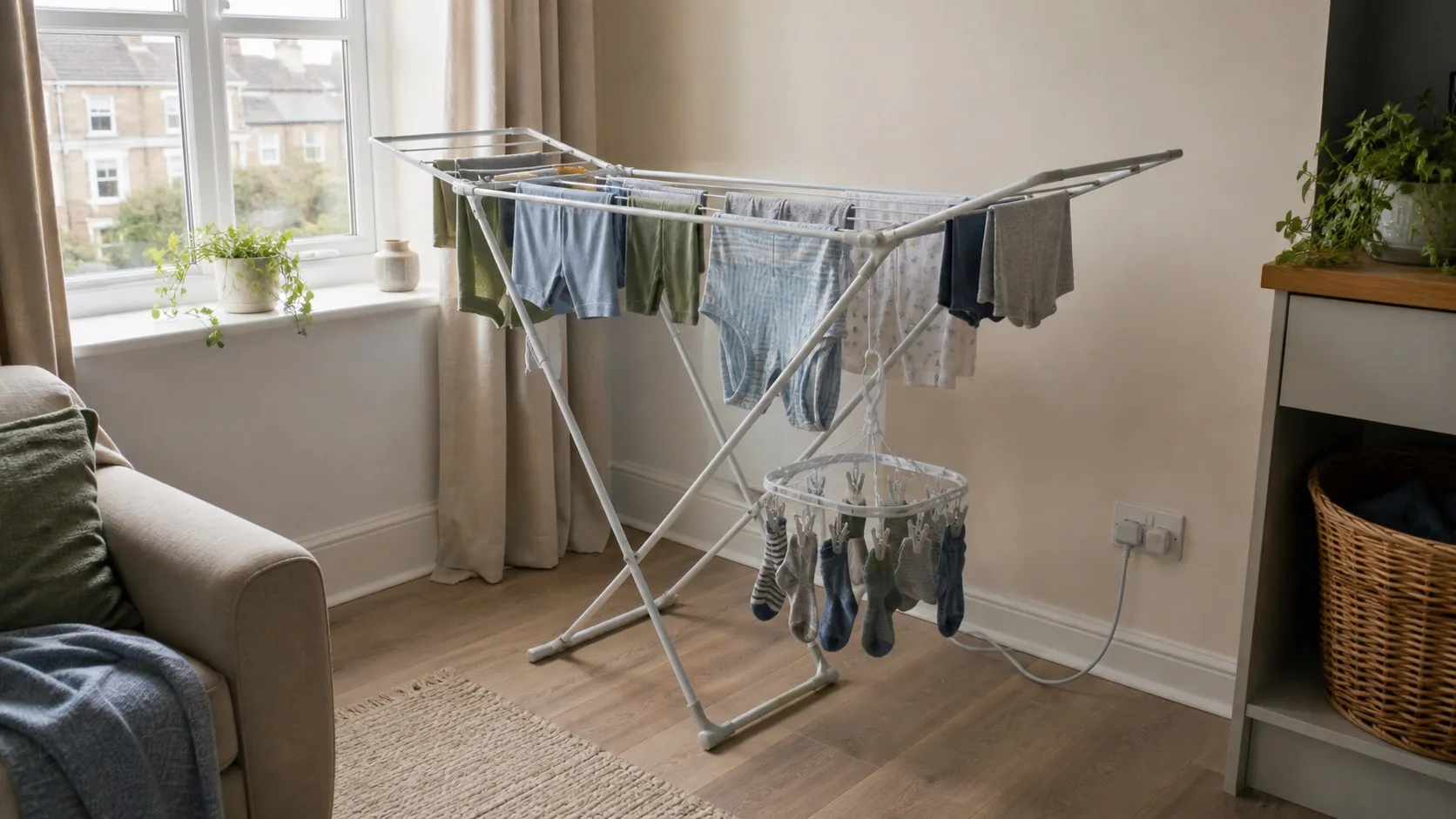
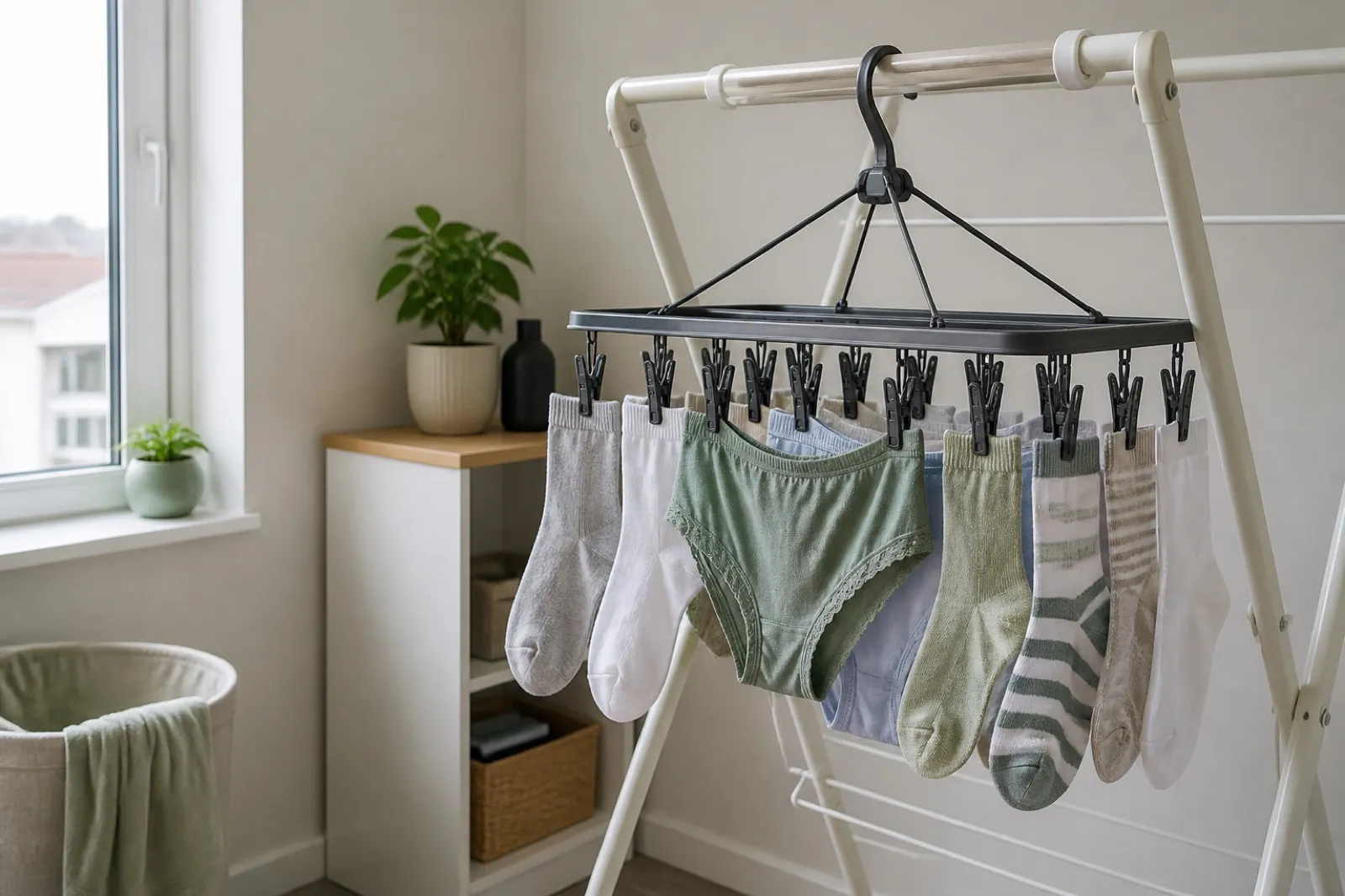
For socks, underwear, baby clothes and other small items, a heated airer offers flexible capacity. You can hang only what is needed, remove dry pieces individually and fold many airers away afterwards. A sock and underwear drying hanger can use vertical space, though the accessory itself is normally unheated.
The drawback is temporary floor space. Measure the airer’s open dimensions and allow room to walk around it safely. A rack that stores behind a door can still dominate a small bedroom while loaded.
A tumble dryer avoids an open rack and contains much of the moisture, but it occupies permanent space. Condenser and heat-pump dryers need space and ventilation clearances specified by the manufacturer; vented dryers also need a suitable route outdoors. A combined washer-dryer can save floor space, although its energy use and drying capacity must be assessed from its own label and instructions.
Care labels matter whichever method you use. Elasticated underwear, delicate fabrics, waterproof items and some baby products may restrict tumble drying or heated drying. When in doubt, follow the garment label rather than choosing the faster appliance.
Moisture and condensation in a small flat
A heated airer does not remove water from the home. It transfers moisture from laundry into the indoor air. In a compact flat, that can contribute to condensation on cold windows and walls if the moisture has no escape route.
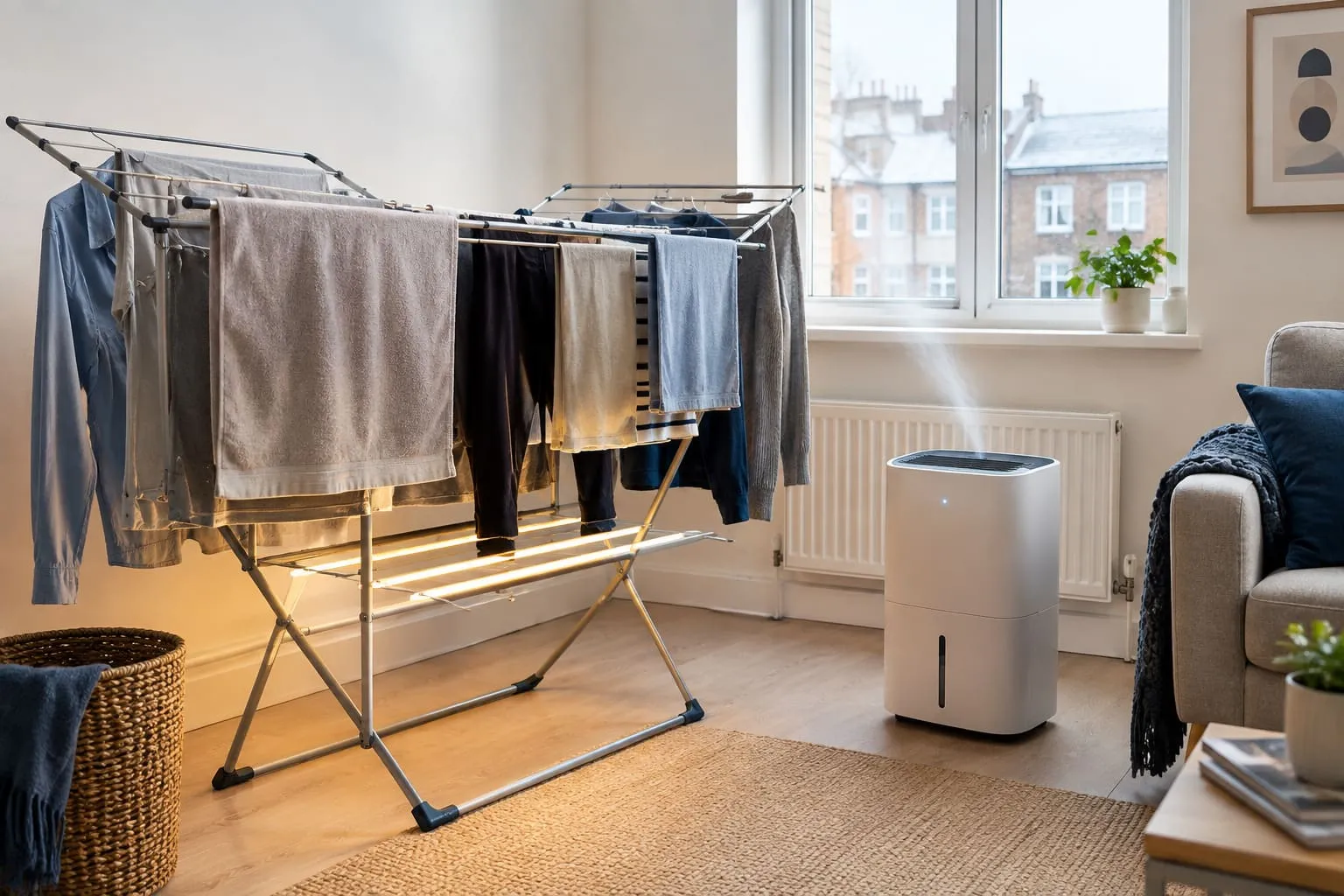
Use suitable ventilation, keep the internal door closed so damp air does not spread through the home, and use extractor fans where appropriate. If opening a window is impractical, a dehumidifier can remove water from the air; our heated airer vs dehumidifier guide explains how those appliances differ.
Condenser and heat-pump tumble dryers collect water in a container or drain it away. Vented dryers expel moist air outside through a duct. None should be installed or operated contrary to the manufacturer’s clearance, drainage or ventilation instructions.
If indoor drying is a regular routine, read our broader guide to drying clothes in a flat without a tumble dryer.
Ways to reduce the cost of either method
The cheapest electricity is the electricity you do not need to use. Practical steps include:
- Spin effectively. Use the highest washing-machine spin that is suitable for the fabrics. Water removed mechanically does not need to be evaporated later.
- Avoid overloading. Leave space between garments on an airer and stay within the tumble dryer’s programme capacity.
- Separate by fabric weight. Thin small garments may finish before towels or jeans, so remove them rather than continuing to dry everything together.
- Use automatic controls appropriately. A timer can prevent an airer running longer than intended, while a tumble dryer’s sensor programme may avoid unnecessary heating. Follow the appliance instructions.
- Maintain airflow. Keep tumble-dryer filters clean and do not block an airer’s controls, cable or any permitted cover ventilation.
- Check the tariff. If you have a time-of-use tariff, the same kWh may cost less at certain times. Do not leave an appliance unattended unless its manufacturer explicitly permits it.
Heated airer or tumble dryer: the bottom line
A heated airer usually costs less per hour, and it can be a practical, fold-away choice for small garments in a flat. A tumble dryer uses more power while running, but a defined cycle can make the full-session cost competitive—especially for an efficient heat-pump model or a well-spun load.
There is no honest universal winner per load. Compare the airer’s kW × hours with the tumble dryer’s labelled or measured kWh per cycle. That one calculation tells you which costs less for your appliances, tariff and laundry routine.