Under-stairs space is one of the most useful pieces of awkward storage in a small UK home, but it is also one of the easiest to waste. The usual failure is to treat it like a normal cupboard: put a shelf across the back, stack things in front of it, then discover six months later that reaching the Christmas decorations requires unloading half the hallway.
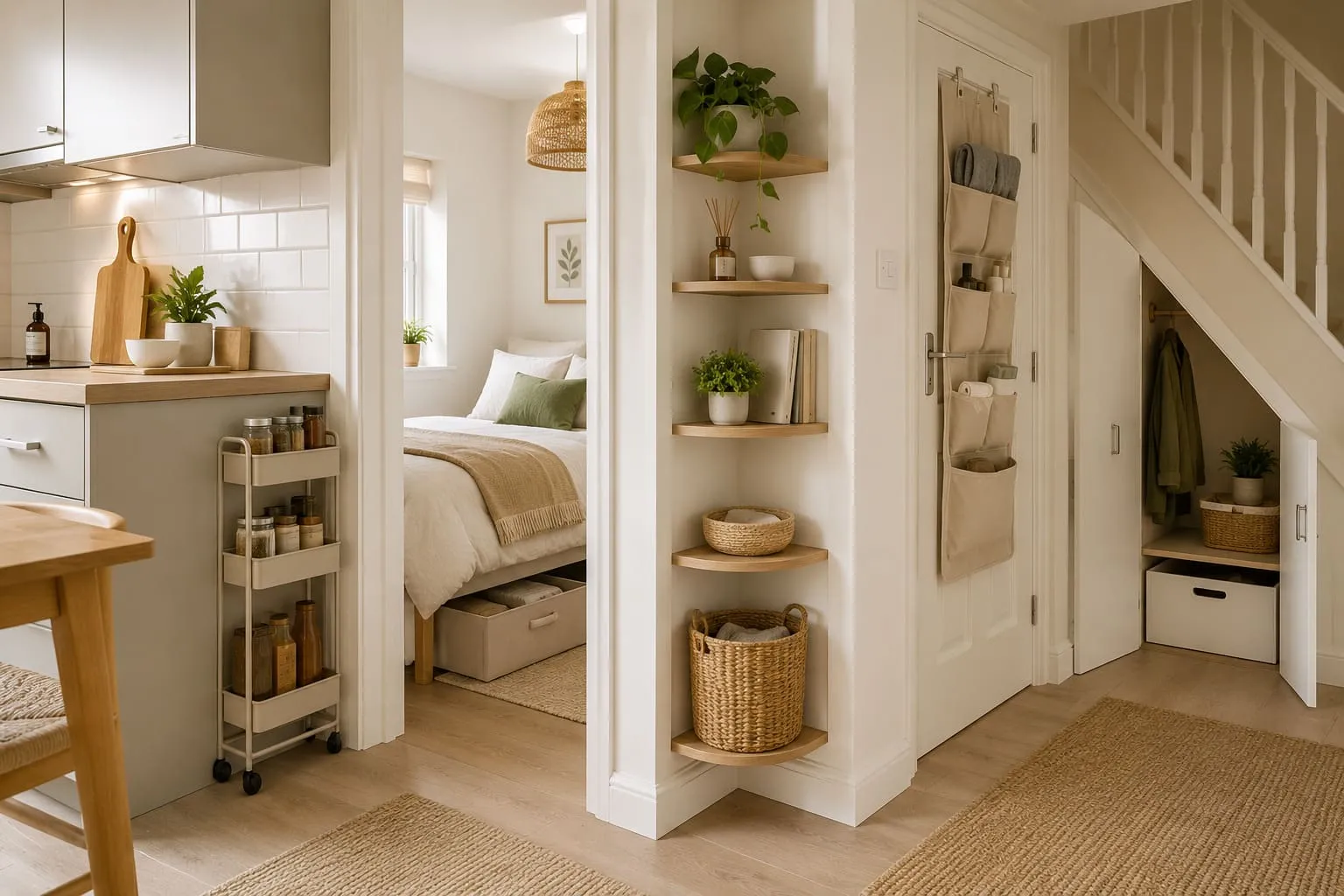
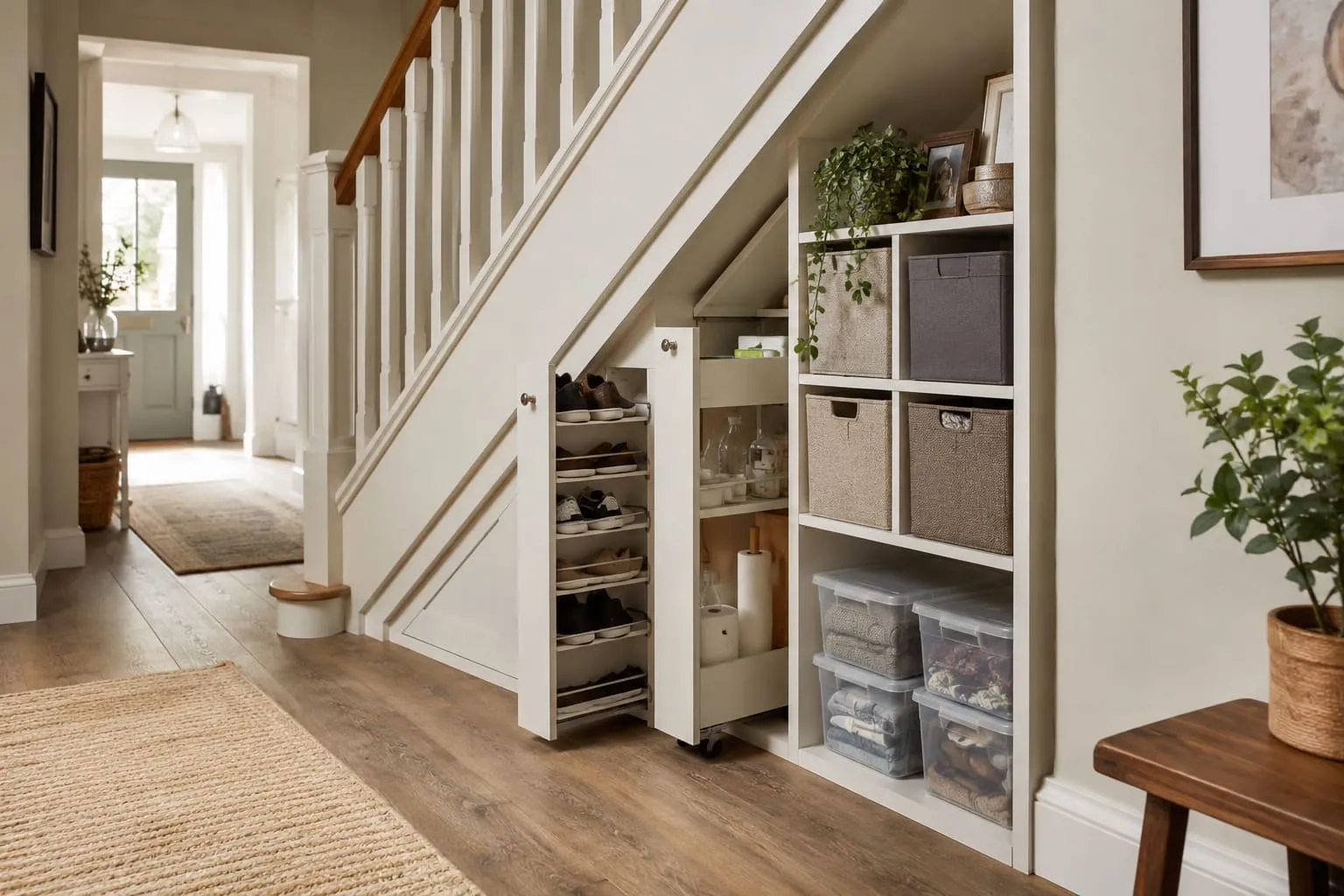
A better approach is to work with the triangle. The tall end is premium storage because you can stand in front of it and reach things easily. The middle section is good for modular shelves, shoes and pull-out storage. The low wedge at the far end is best for contained items you only need occasionally.
For most homes, we would not start with expensive fitted joinery. First make the space usable with a mix of stepped modular storage, clear lidded boxes and something that rolls or pulls forward. If that layout proves itself, you can then decide whether bespoke drawers are worth the cost.
Our quick picks
- Best adaptable modular storage: SONGMICS LPC342W01 12-Cube Storage Unit
- Best for the deep low section: Really Useful Box 35L Clear
- Best pull-out storage: Ronlap 3-Tier Slim Storage Trolley
- Best for shoes near the entrance: VASAGLE LBS035B01 4-Tier Shoe Rack
Start by measuring the space as a triangle, not a cupboard
Before buying anything, measure the under-stairs area in at least four places: the overall width, the depth, the maximum height at the tall end and the usable height at several points along the slope.
That last measurement is the one that prevents expensive mistakes. A 90cm-high unit may fit beautifully at one end and become unusable 40cm further along because the stair string drops through its top corner.
Mark the heights on a quick sketch. You do not need design software. A pencil drawing with measurements at roughly 30cm intervals is enough to tell you whether the space wants cubes, boxes, a shoe rack or a custom drawer.
Also measure the opening, not just the void behind it. An under-stairs cupboard can have a surprisingly generous interior but a narrow or angled door that stops a large storage unit from ever getting inside.
1. Use stepped modular cubes to follow the stair slope

SONGMICS
SONGMICS 12-Cube Storage Unit
LPC342W01
Editorial reviewAssessed from specifications, reporting and comparable products — not a long home trial. How we test
A conventional bookcase wastes the triangle above it or simply does not fit. Modular cubes are more forgiving because you can build the unit lower as the stair line drops.
The SONGMICS LPC342W01 uses individual 30 x 30 x 30cm cubes and is designed to be reconfigured into different shapes, including stepped arrangements. The standard 12-cube configuration is listed at roughly 31 x 93 x 123cm, but the real attraction here is that you are not committed to one tall rectangle.
For an open stair recess, we would use the taller cubes nearest the full-height end and step down towards the low point. That gives you visible, separated storage for bags, hats, toys, paperwork or folded household items without trying to commission furniture to an exact angle.
Each cube has a stated maximum static load of 4.5kg, so this is for ordinary household storage rather than toolboxes or dense book collections. Use the supplied anti-tip kit where appropriate, especially if children can climb on the unit.
Best for: renters and owners who want to use the slope without paying for bespoke cabinetry.
2. Put clear lidded boxes in the low, deep section

Really Useful Box
Really Useful Box 35L Plastic Storage Box
35L Clear
Editorial reviewAssessed from specifications, reporting and comparable products — not a long home trial. How we test
The lowest part of the stair void is rarely good everyday storage. If you have to crouch, reach past another box and feel around in the dark, you will stop using it.
That area is better for things with a long retrieval cycle: spare bedding, seasonal decorations, DIY consumables, travel accessories, picnic gear or children’s clothes waiting for the next size.
The Really Useful Box 35L is a sensible format because it is clear, stackable and has a lid with clip handles. The listed dimensions are 48 x 39 x 31cm, which makes it large enough to hold useful quantities without becoming so heavy that pulling it forward is miserable.
Clear sides matter more under stairs than they do in a normal cupboard. When three boxes are stacked behind a door, being able to identify the contents before unstacking them saves a surprising amount of friction.
Use one box type where possible. Random containers rarely stack cleanly, and every wasted gap becomes more noticeable in a sloping space.
Best for: seasonal and less-used belongings at the low end of a deep stair cupboard.
3. Use a narrow trolley where fixed shelves would create a dead strip

Ronlap
Ronlap Slim Storage Trolley 3-Tier
3-Tier Slim Rolling Cart
Editorial reviewAssessed from specifications, reporting and comparable products — not a long home trial. How we test
A narrow leftover strip beside a larger unit often becomes a graveyard for umbrellas, carrier bags and things you plan to deal with later. A slim trolley turns that gap into storage you can actually reach.
The Ronlap three-tier trolley has a listed size of 22 x 40 x 64cm and runs on wheels. That makes it useful for the middle section of an under-stairs cupboard where there is enough height for several tiers but not enough width to justify a full cabinet.
The biggest advantage is access. You can pull the whole trolley out, take what you need and push it back. This is much better than installing deep shelves and then reaching through the front row every time you need a bottle of floor cleaner or a pack of spare bulbs.
Use it for light, frequently accessed items: cleaning cloths, sprays, shoe-care products, pet supplies, reusable bags or household refills. We would not use a lightweight plastic trolley as a substitute for heavy-duty tool storage.
Best for: narrow gaps and renters who need storage that can move with them.
4. Make the tall hallway end a proper shoe zone

VASAGLE
VASAGLE 4-Tier Narrow Shoe Storage Organiser
LBS035B01
Editorial reviewAssessed from specifications, reporting and comparable products — not a long home trial. How we test
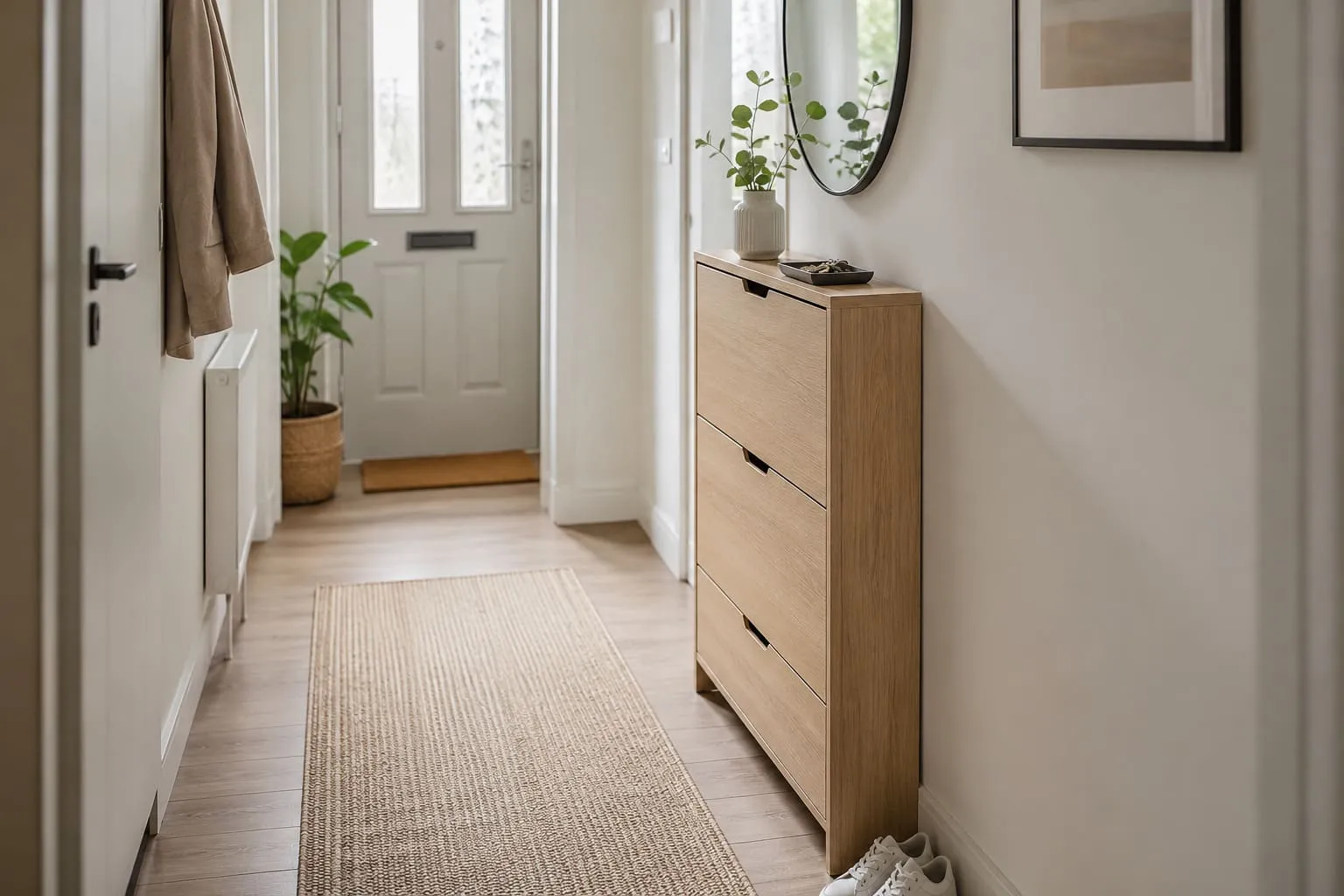
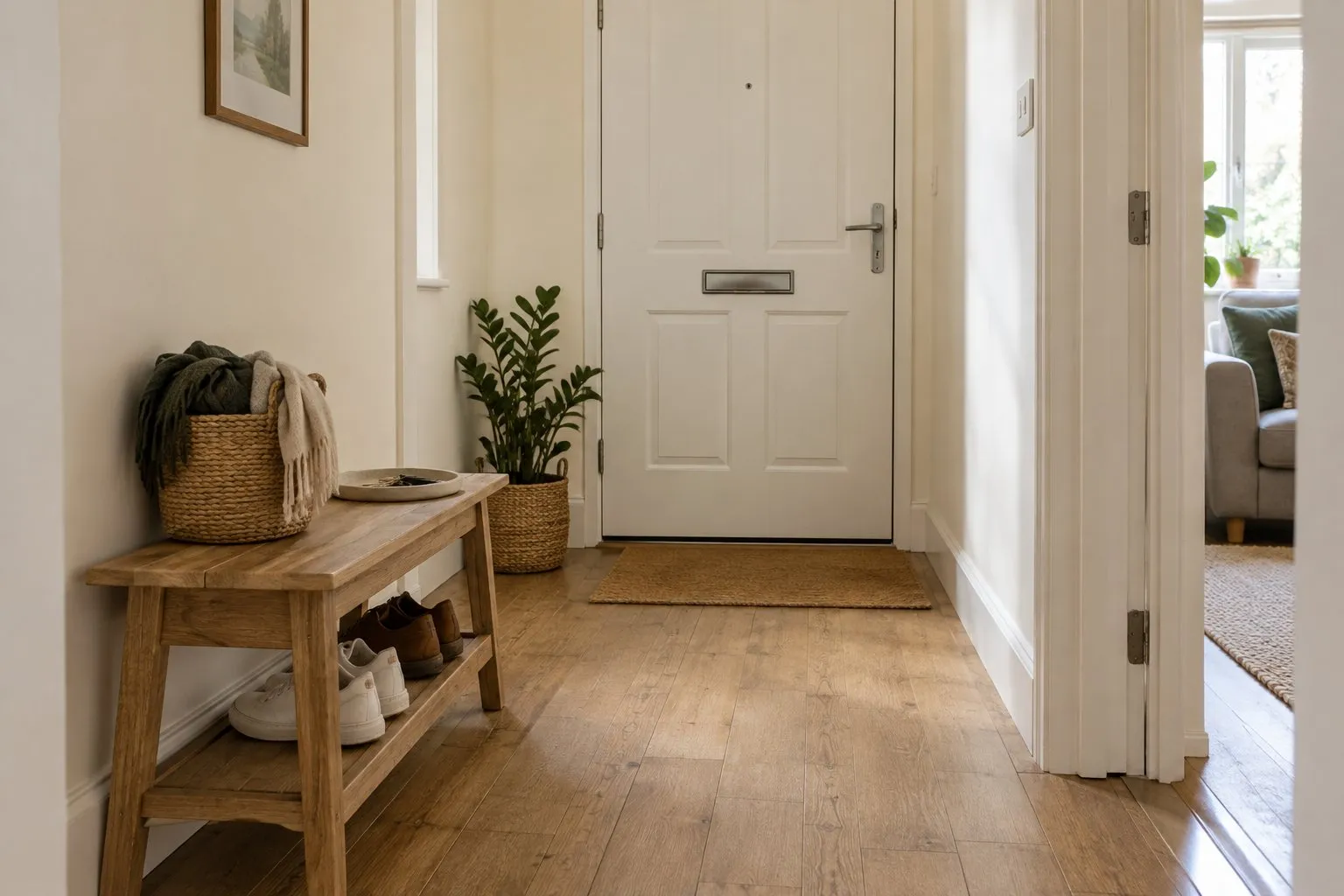
If the staircase starts close to the front door, shoe storage is often the highest-value use of the accessible end. Shoes are used every day, they create visual clutter quickly, and a shallow rack can keep them out of the walking line without consuming the whole stair void.
The VASAGLE LBS035B01 is 30cm deep, 75cm wide and 71cm high, with three fabric shelves plus a top surface. Those proportions suit the taller end of many under-stairs recesses better than a deep hallway cabinet.
The top is useful as a controlled drop zone for a bag or small basket, but do not let it become another pile. Under-stairs storage works when each level has a job: shoes below, one small category above, and nothing spreading into the route to the door.
If your household owns more shoes than the rack comfortably holds, rotate by season rather than stacking pairs two or three deep. Keep everyday shoes accessible and move occasional pairs into labelled boxes further under the stairs.
Best for: hallway stairs where shoes are the main source of ground-floor clutter.
5. If you own the home, pull-out drawers make the best use of the triangle
Bespoke under-stairs drawers are expensive for a reason: they solve the access problem as well as the shape problem. Instead of opening one door and reaching into a deep wedge, each section slides into the hallway.
They are particularly good for family homes where the stair void needs to store shoes, school bags, sports kit, coats or bulky household supplies every day.
The key is to design by drawer depth and load, not just by appearance. A very deep drawer full of shoes can become heavy. Tall pull-outs need reliable runners and anti-racking construction. If the staircase, wall or fire protection is being altered, use a competent tradesperson rather than treating it as a cosmetic cupboard project.
For a rental, modular storage gets you much of the functional benefit without making permanent alterations.
6. Use the full-height side wall for hooks, not another deep shelf
The vertical wall under the highest part of the stairs is useful because it gives you storage without adding much depth.
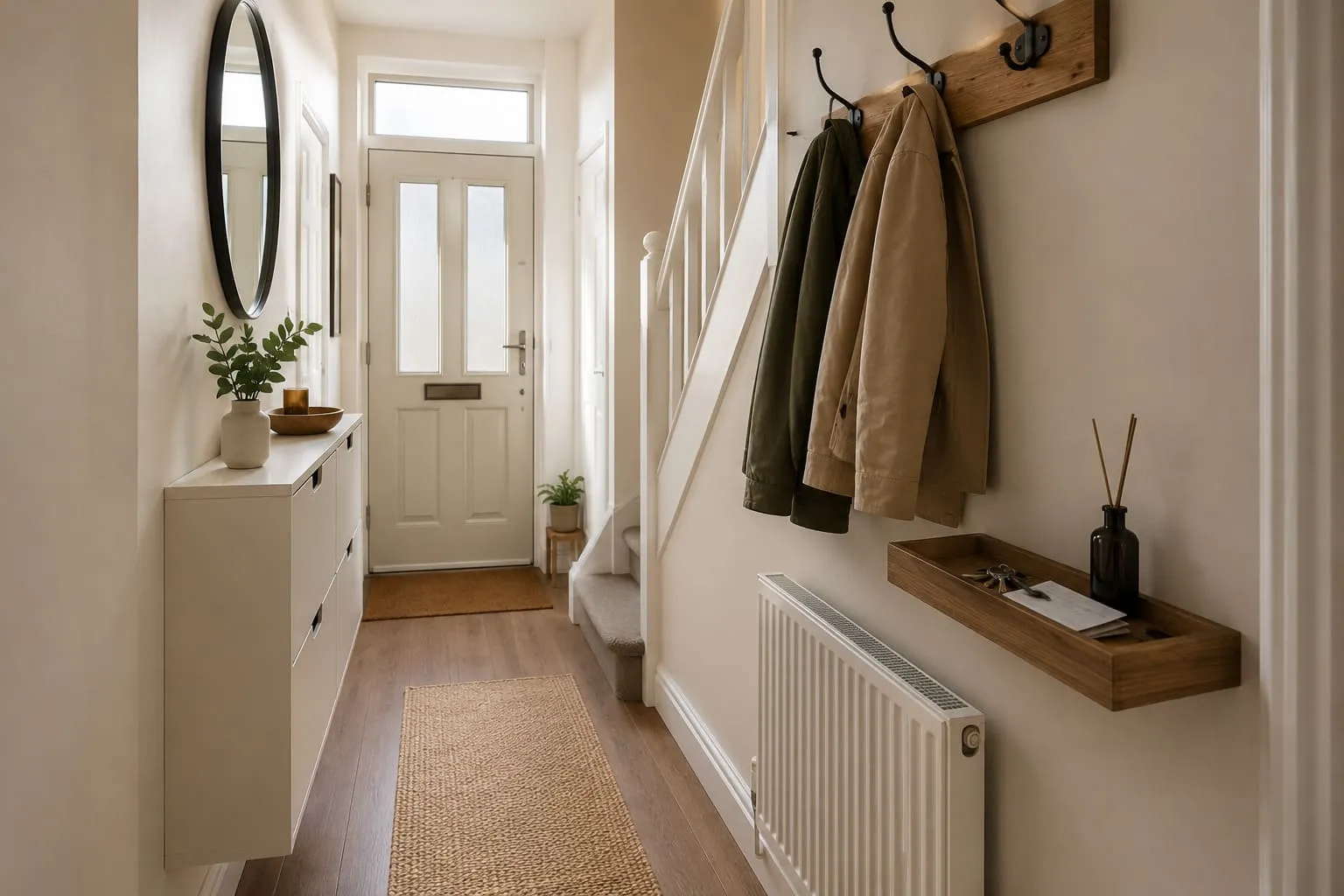
A short rail, sturdy hooks or a pegboard can hold umbrellas, shopping bags, dog leads, a dustpan and brush or lightweight cleaning tools. Keep frequently used items nearest the opening and avoid hanging bulky coats where they narrow the hallway.
This is also a good place for a small labelled basket for keys, gloves or children’s outdoor accessories if the under-stairs area is part of the entrance.
The mistake is to cover every square centimetre with hooks. Leave enough empty wall that items can be removed without disturbing everything around them.
7. Build storage in layers of frequency
The easiest way to keep an under-stairs cupboard organised is to decide how often each item deserves to be reached.
Daily items belong at waist-to-floor height near the opening: shoes, bags, dog leads, umbrellas and cleaning essentials.
Monthly items can sit in the middle: spare toiletries, bulk household supplies, tools you use occasionally and backup light bulbs.
Seasonal items can go into the low or deep section: Christmas decorations, picnic gear, fans, winter accessories or luggage add-ons.
This is more useful than organising only by category. A perfectly labelled box of hats is still in the wrong place if you have to move three suitcases to reach it every morning.
8. Do not fill the floor if you need to crawl into the cupboard
Some under-stairs cupboards are deep enough to enter. In that case, a narrow clear path is storage infrastructure, not wasted space.
Keep one side relatively open so you can reach the back without unloading the front. Put shallow shelves or hooks on the wall and boxes along the lowest side rather than covering the entire floor with containers.
If you cannot physically reach a storage position without moving several other things first, treat that position as archive space only.
What not to store under the stairs
Under-stairs storage is often part of the hallway and may sit directly beside the route you would use to leave the home in an emergency. That makes safety more important here than in a bedroom cupboard.
UK government fire-safety advice emphasises keeping stairways and escape routes clear. Guidance for protected stairways also treats cupboards opening onto the stair enclosure as part of the fire-safety design, so do not casually remove or alter fire-resisting construction or doors.
We would also avoid using an under-stairs hallway cupboard as a charging station for e-bikes, e-scooters or large lithium-ion batteries. London Fire Brigade advises storing and charging these away from main through-routes and exits, and never blocking an escape route with them.
Do not box in or obstruct electrical consumer units, gas meters, stopcocks, boilers, ventilation grilles or inspection points. If your cupboard contains services, keep the required access clear and follow the relevant appliance or utility guidance.
The best layout for different under-stairs spaces
Open triangular recess
Use stepped modular cubes or made-to-measure shelving. Keep the lowest end visually simple with one or two matching boxes rather than trying to fill every centimetre.
Enclosed cupboard with one door
Prioritise pull-out storage. A wheeled trolley, crates with handles and clearly labelled boxes are more useful than deep fixed shelves.
Hallway stairs beside the front door
Make shoes and everyday grab-and-go items the first zone. Put seasonal storage deeper inside.
Tiny low wedge
Do not force furniture into it. Use one or two correctly sized lidded boxes, or leave part of the void empty if access is poor. Storage that cannot be retrieved easily is not useful capacity.
A simple under-stairs setup we would use
For a typical small terraced house or flat with an enclosed stair void, we would start with a shallow shoe rack at the tall end, a slim trolley beside it for cleaning and household supplies, and matching clear boxes pushed into the lower rear section.
If the space is open, we would swap the trolley for modular cubes stepped down with the staircase.
Live with that arrangement for a few months before paying for fitted cabinetry. You will quickly learn which categories need more room, which items should move elsewhere and whether pull-out drawers would genuinely improve the space.
Our final recommendation
The best under-stairs storage is not the system that fills the most cubic centimetres. It is the one that lets you retrieve things without dismantling the cupboard.
For the most adaptable low-commitment setup, start with the SONGMICS 12-Cube Storage Unit and configure the cubes to follow the slope. Use Really Useful 35L boxes for the awkward low section, add the Ronlap slim trolley where you need pull-out access, and use the VASAGLE 4-Tier Shoe Rack if the stair void is part of your hallway.
The rule to keep is simple: easy things at the tall end, occasional things at the low end, and nothing important trapped behind another row.