Treat the hallway as a process, not a room to decorate.
People come in wet, take off shoes, dump bags, put down keys and leave again. Every one of those things needs somewhere obvious to go without turning the entrance into an obstacle course.
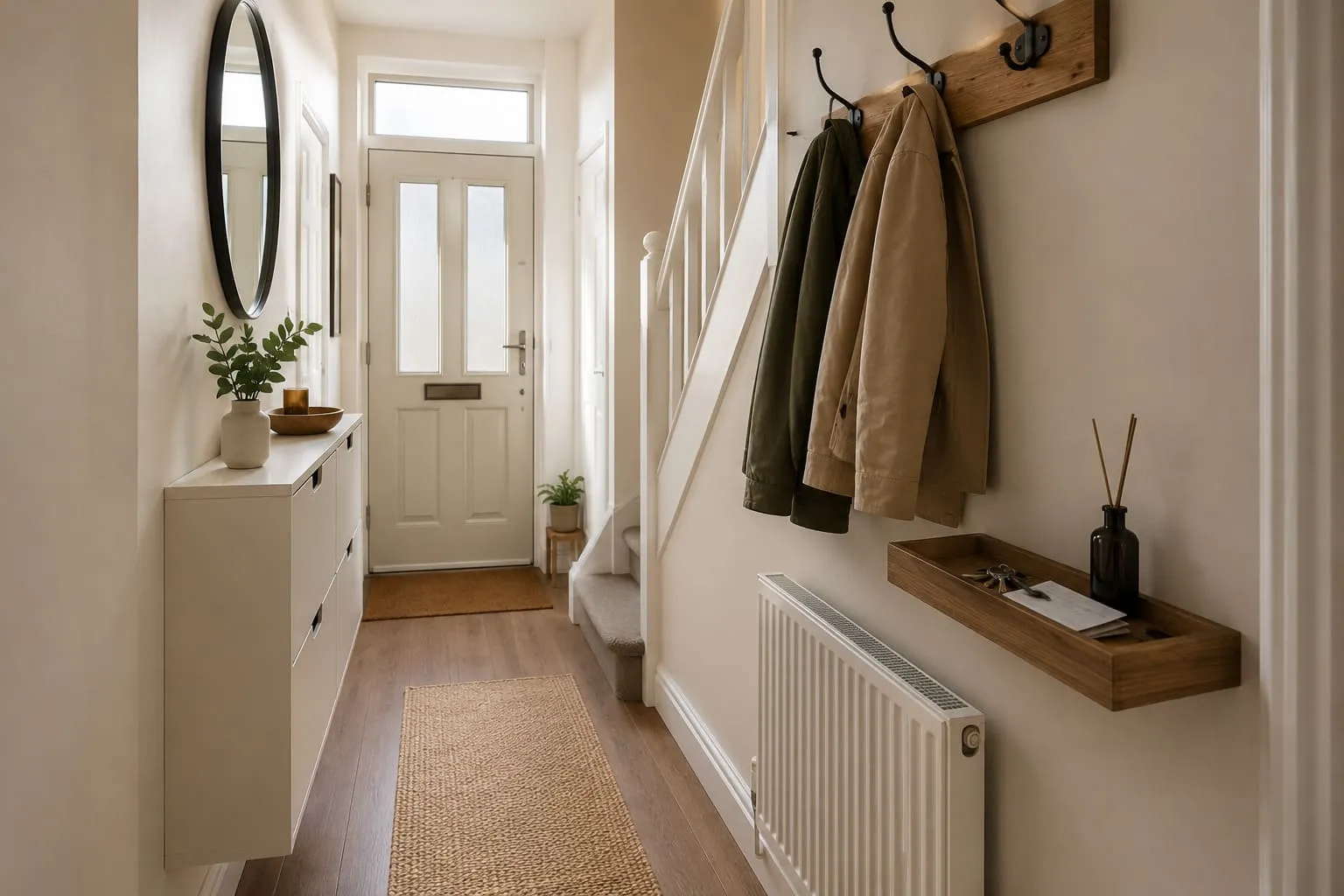
The simplest way to organise a narrow hallway is to keep the floor as clear as possible, use the walls for storage and only keep things near the front door that you actually use regularly.
If the system needs a weekly reset, it will probably fail by Thursday.
Start by removing what does not need to live there
Before buying more storage, remove the things that should not be in the hallway in the first place.
A narrow hall does not need to store every coat, pair of shoes and bag your household owns.
Keep the things currently in use:
- shoes you wear regularly
- coats appropriate for the season
- everyday bags
- keys
- umbrellas
- post waiting to be dealt with
Occasion shoes, spare coats, luggage and seasonal accessories can live somewhere else.
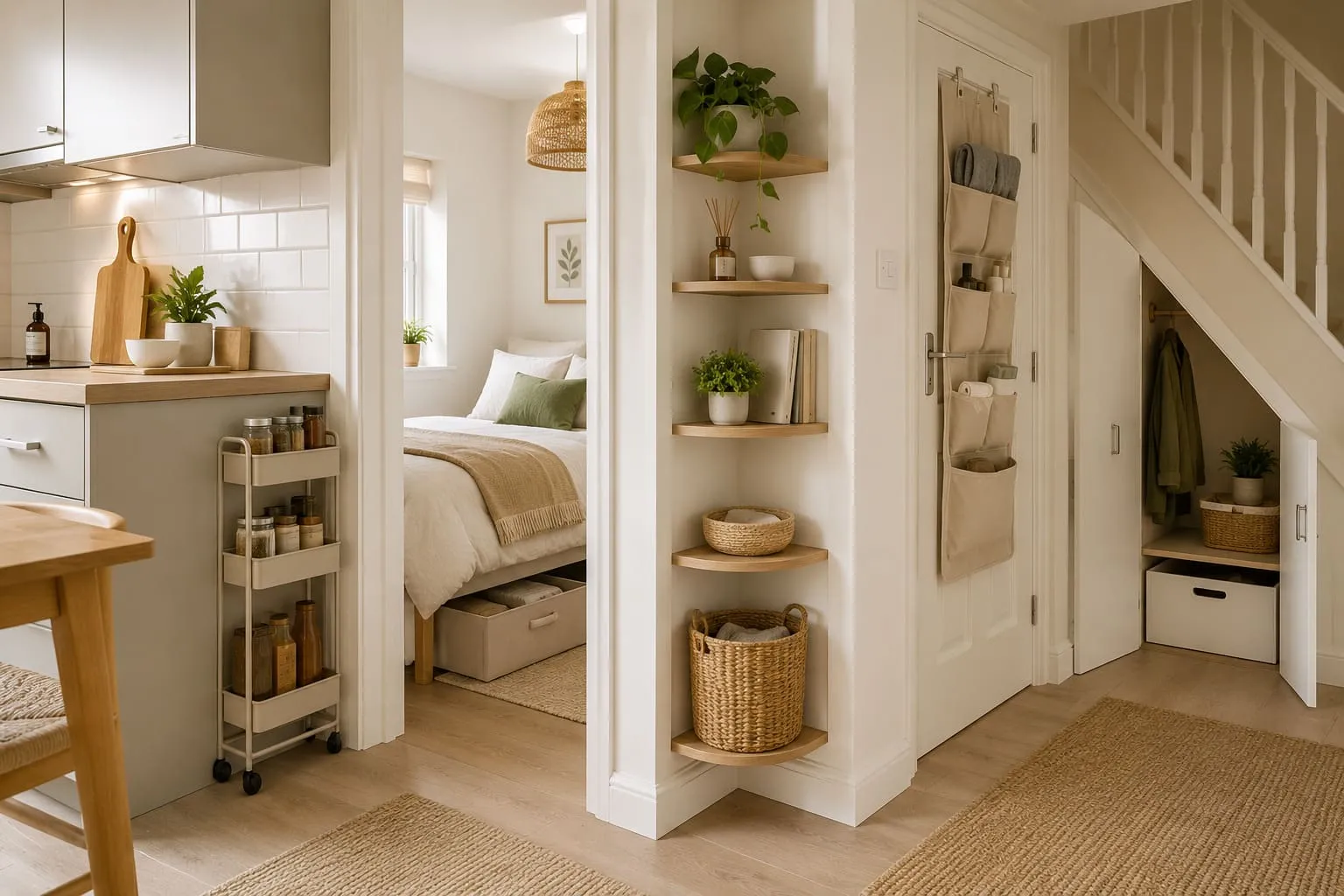
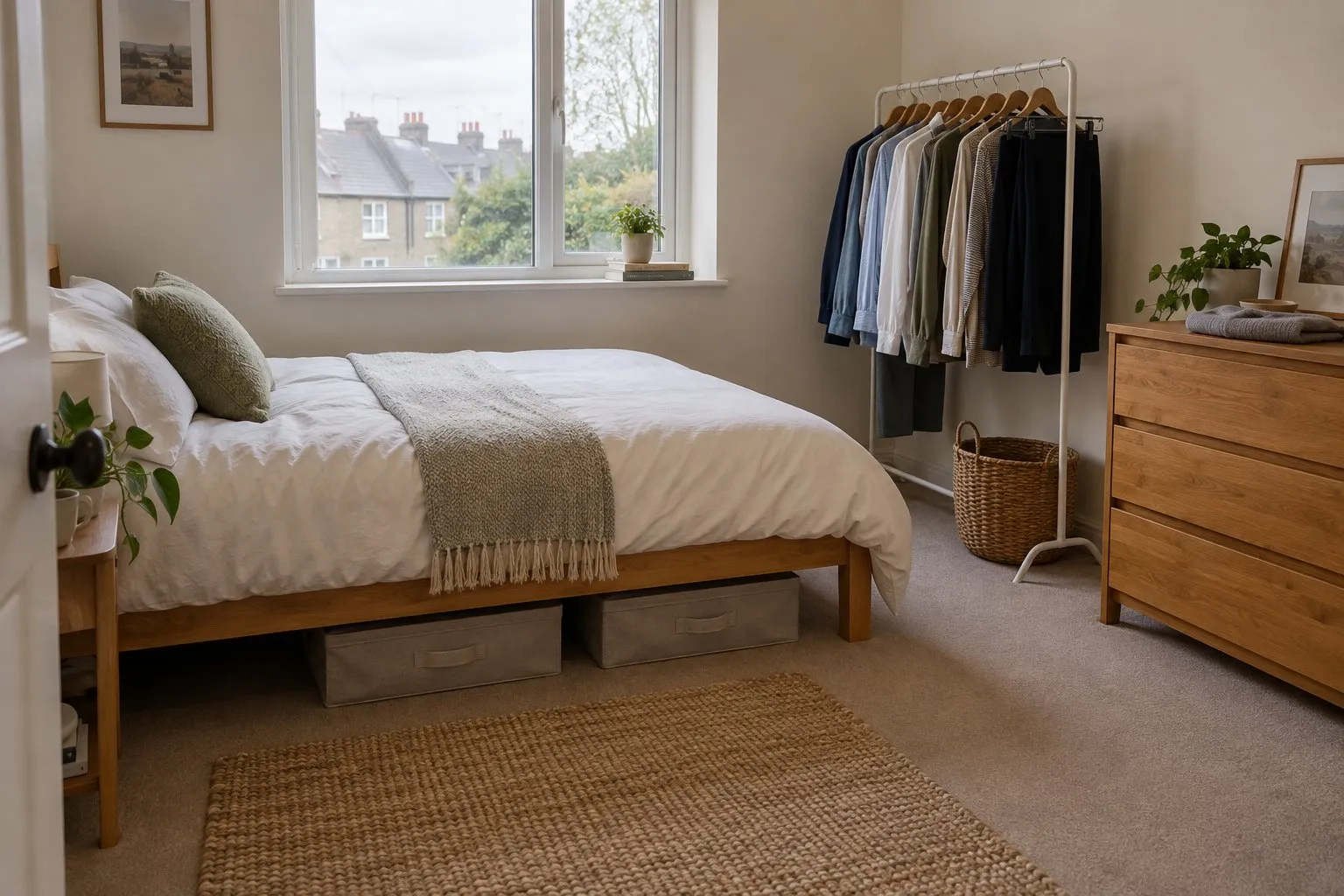
Under-bed storage, a bedroom wardrobe or an under-stairs cupboard may be slightly less convenient, but that is usually better than permanently sacrificing the entrance.
If your hallway has an awkward recess, sloping wall or unused corner, see our storage ideas for awkward spaces.
Give each object a height
One of the easiest ways to create more storage in a narrow hallway is to use the wall vertically instead of lining everything up across the floor.
- Floor: shoes only, ideally just the pairs in use this week.
- Waist height: keys, post and small everyday items.
- Shoulder height: coats and bags you actually use.
- Above that: hats, scarves and less frequently used items.
The important part is that each level has one job.
A floating shelf intended for keys should not slowly become permanent storage for unopened post, batteries, tote bags and three pairs of sunglasses.
Coats on a single overcrowded hook become a damp curtain that hits you in the face. Two or three properly spaced hooks can be more useful than a 12-hook rail that encourages you to hang half the wardrobe by the door.
Measure the narrowest part of the hallway
Do not measure only the empty wall where you want to put a cabinet.
Measure the hallway when it is actually being used.
Open the front door. Check how far the radiator projects. Look at the bottom of the stairs. Imagine someone standing there taking off a wet coat while another person tries to get past.
The narrowest usable point is what matters.
This is particularly important in older UK terraces and flats, where a hallway may change width along its length.
Keep a clear walkway
Mark a mental centre line through the hall.
Nothing should permanently live in it.
Not a plant. Not a console table “for ambience”. Not the laundry basket waiting to go upstairs.
In a genuinely narrow hallway, empty floor is useful space.
Wall-mounted storage normally earns its place more easily than furniture standing on four legs.
Keep shoes to one shallow spot
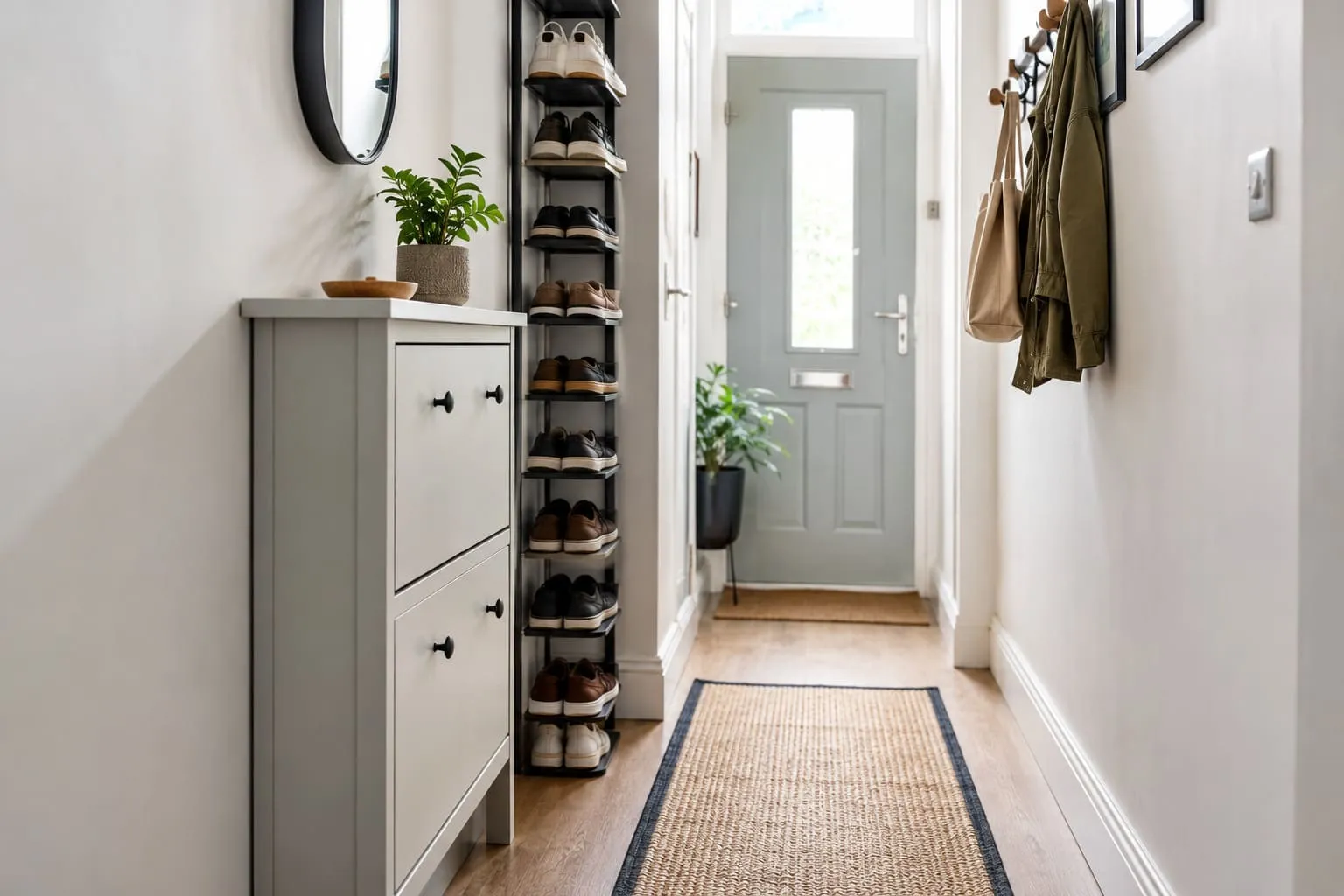
Shoes are usually the biggest source of floor clutter. Keep only the pairs currently in rotation by the door and give them one shallow, closed or vertical home rather than a pile on the floor.
For product picks and the width and depth measurements to check, see our guide to narrow shoe racks.
Use fewer coat hooks, not more
A large row of hooks sounds efficient until every hook has two coats hanging from it.
Then the wall becomes 30cm of fabric.
Wet coats overlap, bags disappear underneath them and sleeves brush anyone trying to walk past.
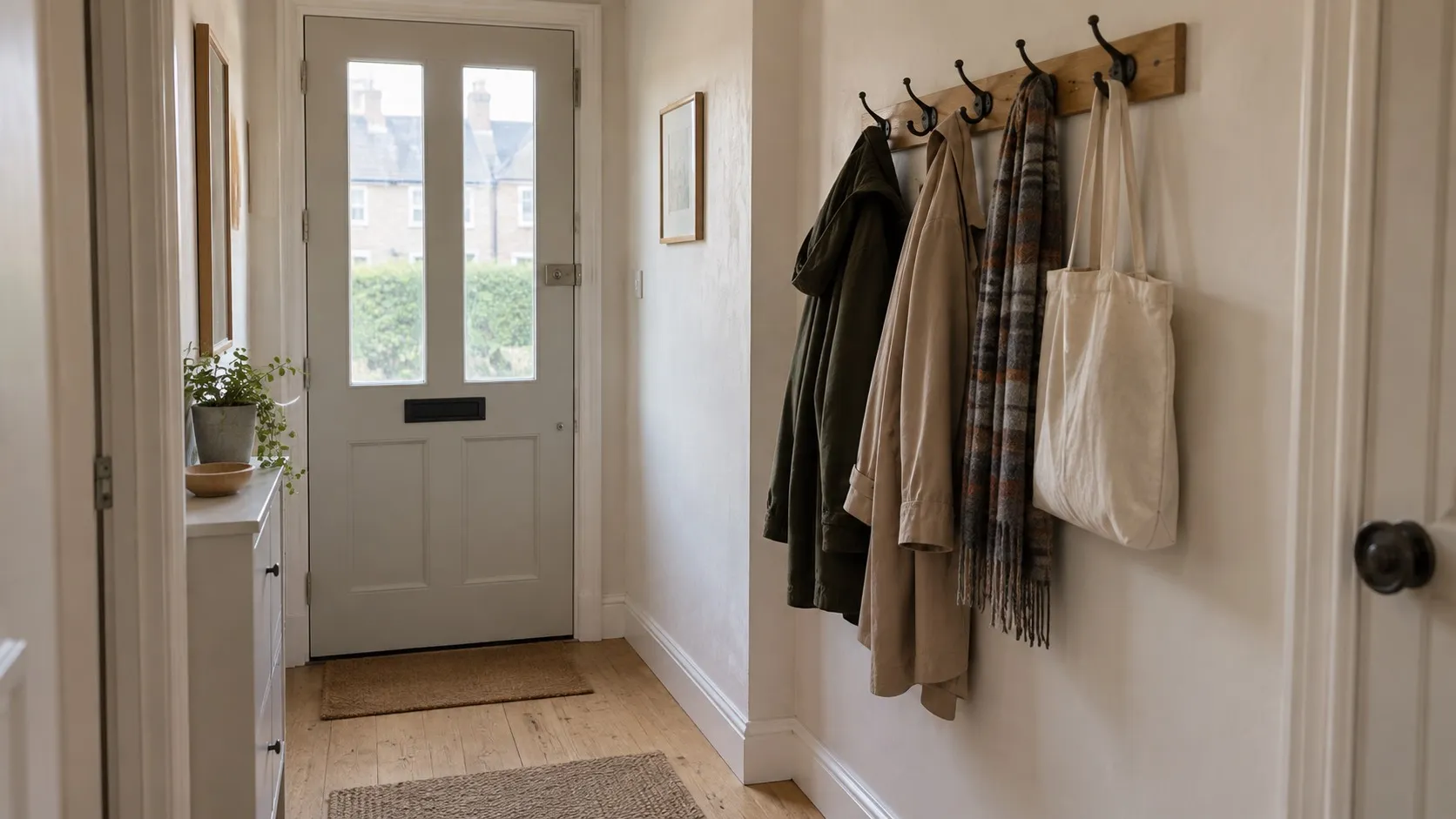
A few well-spaced hooks are usually better in a narrow hall.
If several people use the hallway, giving each person a hook or small section can also stop one huge pile developing.
Keep out-of-season coats in a wardrobe or elsewhere.
Give bags somewhere deliberate to go
Bags are awkward because they are too large for most shelves but used too frequently to be put away properly every evening.
Avoid leaving them on the floor.
A sturdy hook can work for a light everyday bag. School bags and heavier rucksacks may be better on a lower hook, in a basket or beneath the stairs.
The rule is the same as with coats: keep the bags you actually use in the hallway, not every bag you own.
Create a small drop zone for keys and post
Most narrow hallways do not need a console table.
They need somewhere to put keys.
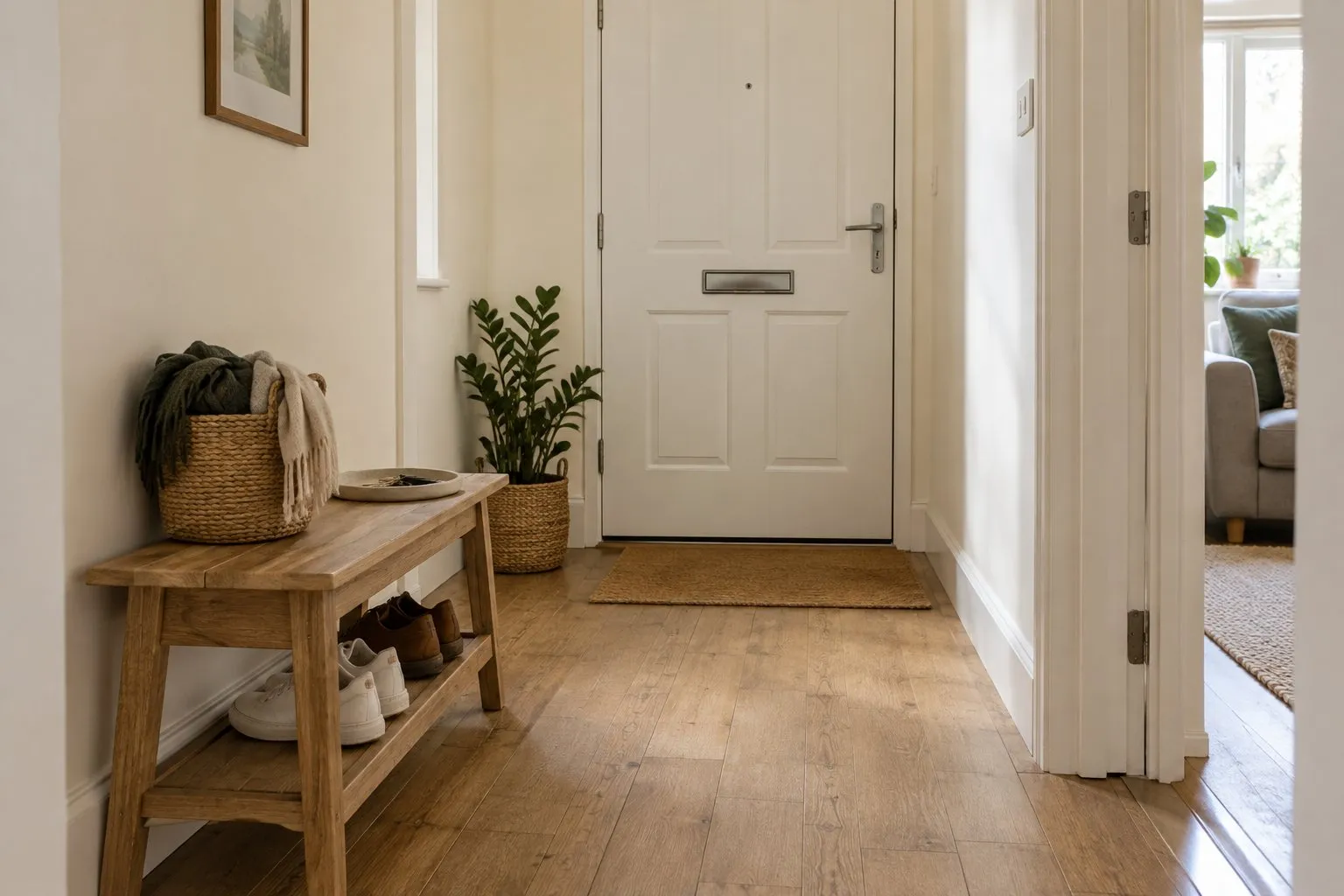
A tiny floating shelf, wall pocket or small tray can do the job without using valuable floor space.
Keys go in one place. Incoming post goes in another.
Try not to create a large horizontal surface simply because you want a drop zone. Large surfaces attract clutter.
A small shelf with enough room for keys is less likely to become a three-month archive of takeaway menus, envelopes and loose change.
Stop post and parcels taking over
Post has a habit of moving.
It arrives by the front door, gets placed on a shelf, moves onto the stairs and eventually joins another pile upstairs.
Give incoming letters one temporary home.
A wall-mounted letter holder or single tray is enough for most households. Deal with it regularly rather than adding more storage for an administrative problem.
Parcels are different.
In a small hallway, large boxes should be unpacked or moved elsewhere rather than becoming temporary furniture.
Work around radiators rather than fighting them
A radiator can remove the most obvious storage wall from a narrow hallway.
Do not compensate by putting a deep cabinet directly opposite it if that creates a bottleneck.
Look at the unused wall above, a nearby recess or the space beneath the stairs instead.
Be careful about placing storage where it blocks radiator controls, meters, electrical cupboards or anything else you may need to access.
Sometimes the best storage solution is simply leaving that section of wall alone.
Leave space for wet coats
UK hallways have another problem: rain.
Wet coats on a packed rail stay wet for longer and can make a small entrance feel stuffy.
Leave some air between coats rather than crushing everything together.
Let umbrellas drain somewhere appropriate before putting them away, and avoid storing damp outerwear tightly against a wall or inside a closed cupboard.
This is another reason not to fill every available hook.
Use high storage for occasional items
The space above a doorway or high on a hallway wall can be useful, but only for the right things.
High shelves or baskets can work for:
- hats and gloves out of season
- spare tote bags
- cycling accessories
- dog-walking supplies
- infrequently used household items
Frequently used things should stay within easy reach.
There is little benefit in creating more storage if using it becomes annoying.
Lower the system if you have children
A perfectly organised adult hallway can collapse as soon as children start using it.
If they cannot reach the hooks, their coats will end up somewhere else.
Lower hooks for coats, school bags and PE kits can make more difference than adding another cabinet.
The same applies to shoes. Give school shoes an obvious home that does not require opening several doors and rearranging six other pairs first.
Make putting things away easier than dropping them.
Keep decorative surfaces to a minimum
Hallway styling is fine, but every piece of furniture competes with storage and circulation in a narrow entrance.
A mirror is useful. A picture may look good. A small plant can work if there is genuinely somewhere sensible for it.
You probably do not need a console table covered in decorative objects.
A narrow entrance usually feels larger when you can see more wall and more floor.
Apply the same rule to coats and bags.
Your hallway storage capacity stays the same even when the amount of stuff you own increases.
Do a 60-second hallway reset
A narrow hallway should not require a Sunday afternoon organising session.
Before bed, take a minute to:
- put stray shoes back
- hang coats properly
- move bags off the floor
- remove post that has been dealt with
- take anything upstairs that does not belong in the hall
If that takes much longer than a minute or two, you are probably storing too much there.
The goal is not to create a perfectly styled entrance.
It is to create a hallway you can walk through without stepping over somebody’s trainers.
A simple layout for a narrow UK hallway
If you are starting from scratch, this arrangement works in many small entrance halls.
Near the front door: keys, umbrellas and post.
Along the clearest wall: shallow or slim shoe storage.
Above or beside it: a few well-spaced coat hooks.
Under the stairs: overflow bags, shoes or household storage if the space is available.
Above head height: seasonal accessories.
Middle of the hallway: absolutely nothing.
That last part matters more than it sounds.
Frequently asked questions
What is the best storage for a narrow hallway?
The best storage for a narrow hallway is usually shallow, vertical or wall-mounted. Slim shoe cabinets, wall hooks, floating shelves and under-stairs storage can provide useful capacity without taking over the walking space.
How do I keep a small hallway from getting cluttered?
Only store things you use regularly in the hallway. Give shoes, coats, bags, keys and post fixed places, and move seasonal or rarely used items elsewhere. A quick daily reset is easier than repeatedly decluttering an overloaded entrance.
Where should coats go in a narrow hallway?
Use a small number of well-spaced wall hooks and keep only current-season coats there. Moving less frequently worn coats to a wardrobe prevents the hallway from becoming crowded with bulky outerwear.
Is a console table a good idea in a narrow hallway?
Only if there is genuinely enough room. In a very narrow entrance, a small wall-mounted shelf can provide a place for keys and post without using valuable floor space.
How can I organise shoes in a narrow hallway?
Keep only frequently worn shoes near the entrance and use shallow or vertical storage where possible. Slim shoe cabinets and wall-mounted options can work particularly well where a conventional rack would project too far into the hallway.
How do I make a narrow hallway look less cramped?
Start by reducing visible clutter and clearing as much floor space as possible. Avoid oversized furniture, use the walls for storage and keep decorative objects restrained. A hallway usually feels larger when there is a clear, uninterrupted route through it.