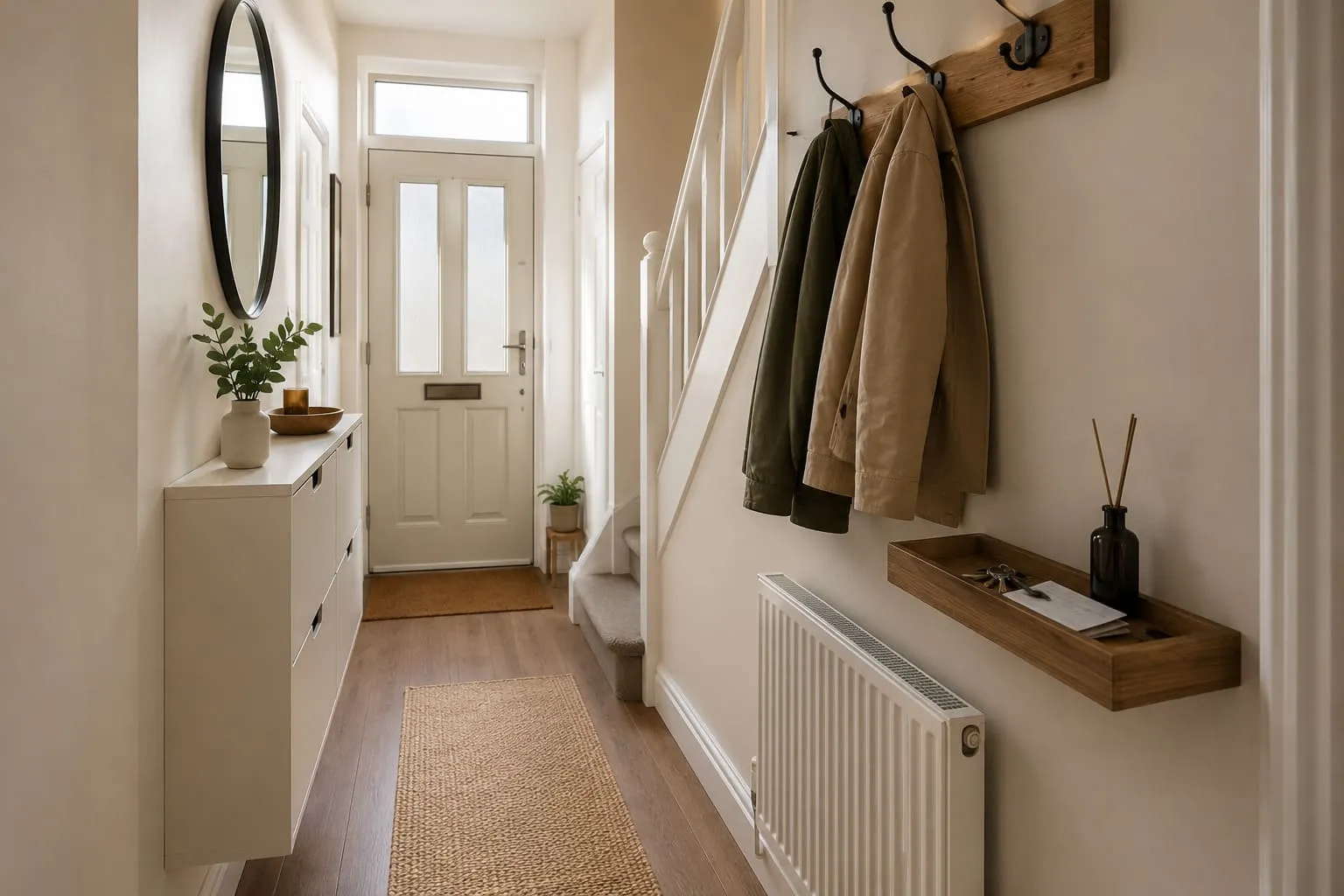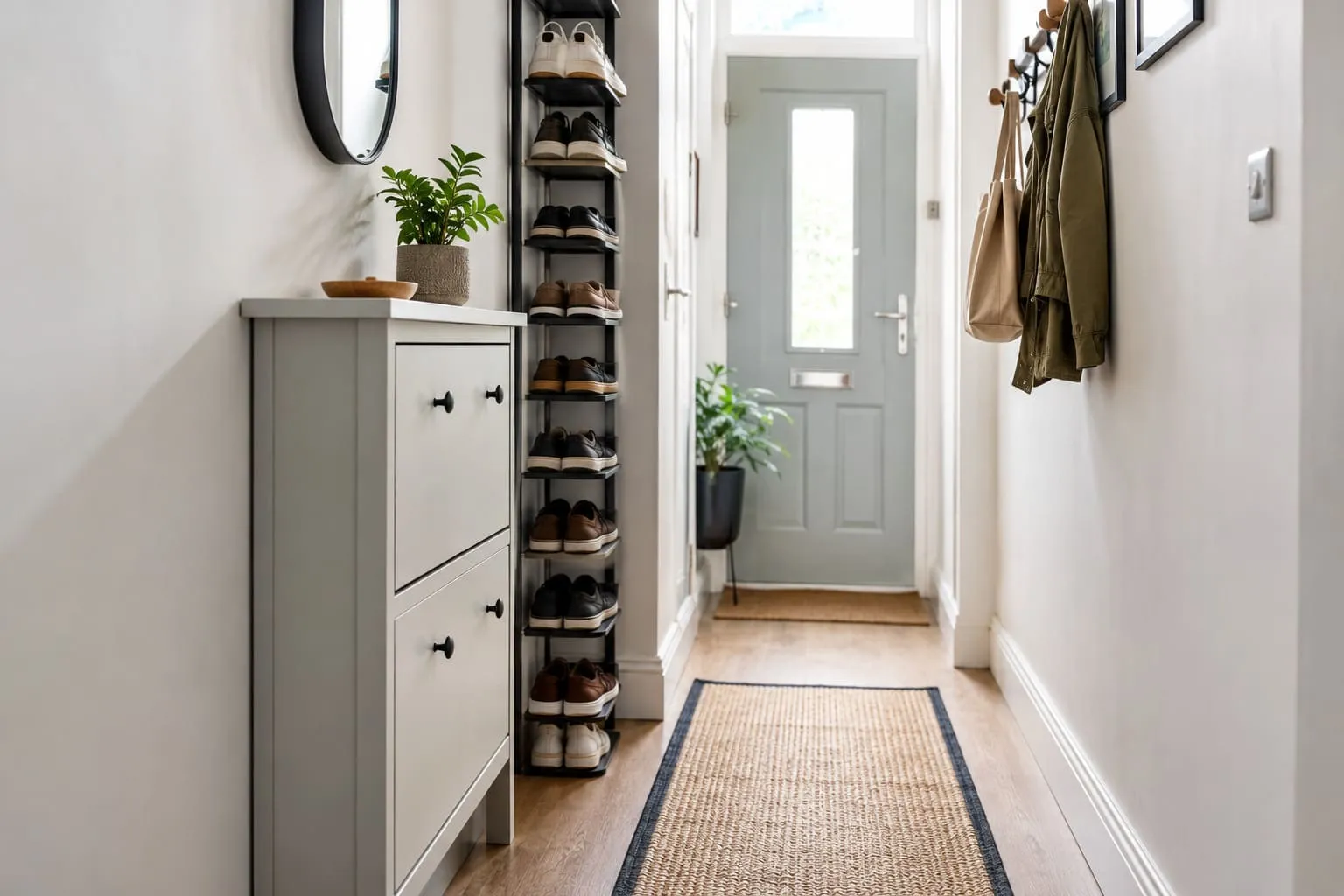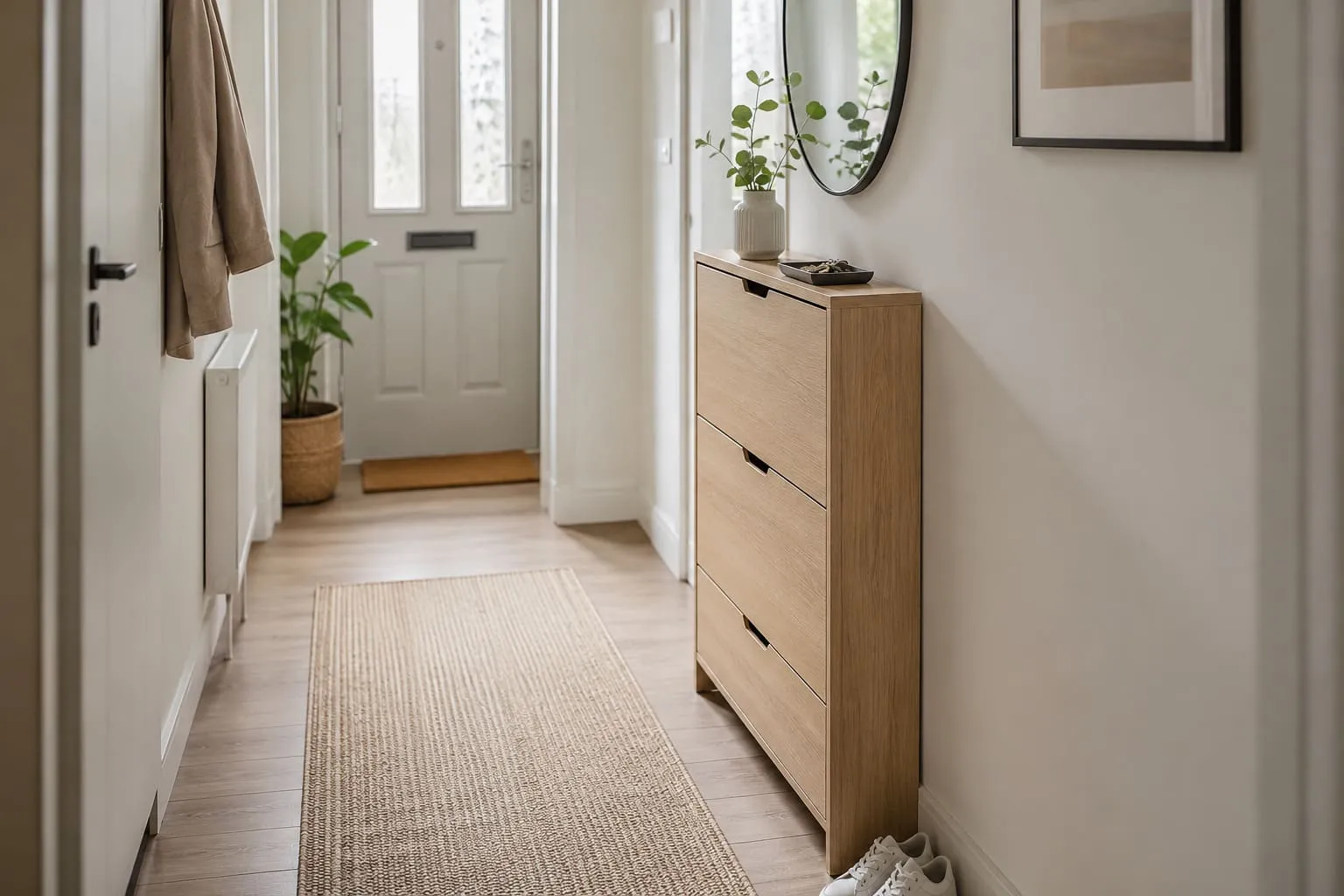
A slim shoe cabinet should solve the hallway problem rather than move it six inches sideways. In a narrow UK entrance, the number that matters first is closed depth. A cabinet can be marketed as slim and still project 30cm or more into the route between the front door, stairs and living room.
For this guide, we prioritised cabinets between 15cm and 24cm deep, then looked at width, shoe-size limits, drawer layout, wall fixing and whether the claimed capacity is realistic for adult footwear. Our top pick is the Atahome Assos 3-Drawer Shoe Cabinet. At 15cm deep and 50cm wide, it takes very little from the passage while giving everyday shoes a closed, wipe-clean home.
Our quick picks
- Best overall: Atahome Assos 3-Drawer Shoe Cabinet
- Best for larger shoes: GFW Narrow White 4 Drawer Shoe Cabinet
- Best budget option: VASAGLE LBC02WT 2-Drawer Shoe Cabinet
- Best for bigger households: Atahome Troy 4-Drawer Shoe Cabinet
What matters in a narrow hallway
Measure depth before you count pairs
Capacity is the seductive number. Depth is the number you live with every day.
If your hallway is 90cm wide, a 30cm-deep cabinet leaves roughly 60cm before you allow for radiators, door handles, coats or somebody standing there to put shoes on. A 15cm cabinet leaves much more breathing room. That difference is why we prefer genuinely shallow flip-down cabinets over conventional cupboards for tight entrances.
Measure from the wall at the cabinet’s widest obstruction, including skirting board if the unit cannot sit over it. Then check how much clear passage remains.
Closed depth is only half the measurement
A flip drawer has to open somewhere. The cabinet may be 15cm deep when shut but temporarily needs more space when you pull a compartment down.
Mark the cabinet depth on the floor with tape, then imagine the drawer open while somebody else is trying to pass. This matters especially opposite a staircase, a front door that swings inward or another cupboard.
Shoe size can undo an impressive capacity claim
A capacity such as “12 pairs” tells you very little unless you know what those pairs are. Slim cabinets work by angling footwear inside flip-down drawers, so long trainers and bulky soles consume more of the usable space than children’s shoes, slippers or flats.
The Atahome Assos and Troy are specified for footwear up to UK size 8.5. The GFW Narrow cabinet is the better option in this shortlist for larger feet, with a listed maximum of UK size 10.
If one person in the home wears particularly long or chunky shoes, measure that pair first. It is better to lose a nominal row of capacity than buy a cabinet that cannot close around the shoes you wear most.
Wall fixing is part of the design, not an optional extra
Tall, shallow furniture saves floor space partly by moving storage upwards. That also means there is less depth resisting a forward pull when a drawer is opened.
Follow the manufacturer’s wall-fixing instructions. The correct fixing depends on whether you have masonry, timber studs, plasterboard or another wall construction, so do not automatically use a generic screw or plug simply because it came in the box.
For renters, this is worth deciding before purchase. A freestanding open rack may be more practical if drilling is not permitted.
Skirting boards can stop a cabinet sitting flat
A 15cm-deep unit that stands 2cm away from the wall because of thick skirting is no longer behaving like a 15cm cabinet in the room.
The GFW Narrow is unusually helpful here because its plinth is shaped to accommodate a skirting board. With other models, check the base geometry, wall-fixing position and the projection of your skirting before ordering.
1. Atahome Assos 3-Drawer Shoe Cabinet — best overall

Atahome
Atahome Assos 3-Drawer Shoe Cabinet
Assos MSC3D
Editorial reviewAssessed from specifications, reporting and comparable products — not a long home trial. How we test
The Assos is the cabinet we would start with for a genuinely narrow hallway. Its footprint is roughly 50cm wide by 15cm deep, so it uses less passage space than most wooden flip-down cabinets while stacking three compartments vertically.
The steel construction is another practical advantage in a busy entrance. It arrives assembled rather than as a flat-pack carcass, and the powder-coated surface is simpler to wipe down after wet pavements and muddy school runs. Atahome lists capacity at approximately six adult pairs plus three children’s pairs, with a maximum shoe size of UK 8.5.
There are two important catches. First, the Assos is designed to be wall mounted, so it is not the choice for someone who cannot drill. Second, the UK 8.5 footwear limit is meaningful. A household with size 9, 10 or bulky running shoes should not choose it just because the external dimensions are excellent.
For one or two people with compatible shoe sizes, however, 15cm depth is difficult to beat. It solves the problem that matters most: keeping shoes behind a closed front without turning the hallway into an obstacle course.
Best for: very narrow hallways, smaller households and adult shoes up to the stated UK size 8.5.
2. GFW Narrow White 4 Drawer Shoe Cabinet — best for larger shoes

GFW
GFW Narrow White 4 Drawer Shoe Cabinet
Narrow 4 Drawer Shoe Cabinet
Editorial reviewAssessed from specifications, reporting and comparable products — not a long home trial. How we test
The GFW takes a different approach. At around 17cm deep, it is almost as shallow as the Atahome steel models, but it spreads four flip-down compartments across a cabinet roughly 102cm wide and 90cm high.
That wide format is useful if you have enough wall length and do not want a tall column of storage. More importantly, the cabinet is listed for footwear up to UK size 10, making it the safer choice here for households whose everyday trainers simply will not fit the Atahome size limit.
The plinth is another thoughtful detail for UK hallways. It is profiled to sit around a skirting board recess, reducing the chance that the whole cabinet has to stand unnecessarily far from the wall. That can make a noticeable difference when every centimetre of passage matters.
The compromise is width. You need just over a metre of uninterrupted wall, so check radiator positions, sockets and door architraves. It is also self-assembly rather than a pre-built steel unit, and it should be securely attached to the wall.
Best for: wider hallway walls, larger adult shoes and homes where a low, broad cabinet works better than a tall column.
3. VASAGLE LBC02WT 2-Drawer Shoe Cabinet — best budget option

VASAGLE
VASAGLE LBC02WT Shoe Cabinet with 2 Flip Doors
LBC02WT
Editorial reviewAssessed from specifications, reporting and comparable products — not a long home trial. How we test
The VASAGLE is not as dramatically shallow as the 15-17cm cabinets above, but its 24cm depth is still compact enough for many entrances and the price is usually much easier to justify.
Its strongest feature is flexibility inside the two flip drawers. The dividers can be adjusted or removed, so you are not locked into one internal arrangement if your shoe collection mixes flats, trainers and taller footwear. The listed external dimensions are about 60cm wide, 24cm deep and 83.5cm high.
VASAGLE’s stated capacity is up to 12 pairs of women’s shoes or eight pairs of men’s shoes. As with every capacity claim in this category, use that as an upper-bound example rather than a guarantee. Large trainers will reduce it quickly.
The extra 9cm of depth compared with the Assos is the deciding factor. In a hallway where 15cm versus 24cm affects whether two people can pass, buy the shallower cabinet. In a less extreme entrance, the VASAGLE gives you a conventional furniture look, adaptable dividers and a lower-cost route to hiding shoe clutter.
Best for: budget-conscious homes with enough passage width for a 24cm cabinet.
4. Atahome Troy 4-Drawer Shoe Cabinet — best for bigger households

Atahome
Atahome Troy 4-Drawer Shoe Cabinet
Troy 4-Drawer
Editorial reviewAssessed from specifications, reporting and comparable products — not a long home trial. How we test
The Troy keeps the Assos formula — 50cm wide and 15cm deep — but extends it to four compartments and roughly 138cm in height. Atahome lists room for around eight adult pairs plus four children’s pairs.
That makes it the most space-efficient option here when you need more capacity but cannot afford to make the cabinet deeper or wider. In a family hallway, vertical storage is often the only direction that does not interfere with the route through the home.
The trade-off is that 138cm is a tall, shallow metal cabinet. It needs secure wall mounting, and you should be comfortable with the visual presence of a narrow storage column near the entrance. It also retains the same stated maximum footwear size of UK 8.5, so more drawers do not solve the large-shoe problem.
If the footwear fits, the Troy is a strong answer to a very specific constraint: more hidden storage without giving up more than 15cm of floor depth.
Best for: families and larger shoe collections where wall height is available but hallway depth is not.
How we would choose by hallway shape
Extremely narrow passage
Choose the Atahome Assos. Fifteen centimetres of depth is the main reason to buy it. The 50cm width also makes it easier to place between door openings than the metre-wide GFW.
Narrow hallway with a long clear wall
Choose the GFW Narrow 4 Drawer if your shoes run larger or you prefer a lower cabinet. Its 17cm depth remains excellent, but the 102cm width needs planning.
Small entrance where 24cm still leaves a comfortable route
Choose the VASAGLE LBC02WT if price matters. It is not our first choice for a truly pinched corridor, but the adjustable dividers make it more forgiving as a general household shoe cabinet.
Family hallway with almost no spare depth
Choose the Atahome Troy. It goes up rather than out, increasing storage while preserving the same 15cm depth as the Assos.
Slim shoe cabinet vs open shoe rack
A cabinet is not automatically better than a rack.
A flip-down cabinet wins when visual clutter is the problem. It hides mismatched shoes, reduces the temptation to build a pile beside the door and gives the hallway a calmer furniture-like surface. Closed storage also makes it easier to keep the floor clear for vacuuming.
An open rack wins on flexibility. There is usually more tolerance for long shoes, boots and wet footwear, and you do not need clearance for a flip drawer. It can also be the safer renter option if you cannot wall-fix tall shallow furniture.
For a very tight hallway, compare both by usable passage after installation, not by product category. A 15cm cabinet is slimmer than most racks; a 30cm cabinet may not be.
How to measure before you order
Start with the tightest point in the hallway, not the broadest. Measure wall to opposite obstruction at skirting level and again higher up if a radiator, banister or handle projects into the route.
Next, subtract the cabinet’s closed depth. Ask whether the remaining passage still works when someone is carrying shopping, a child is putting shoes on or the front door is open.
Then check four smaller details:
- Wall width: allow for architraves, sockets, radiators and switches.
- Skirting projection: confirm whether the cabinet base clears it or will stand forward.
- Drawer swing: make sure an open flip compartment does not block a door or staircase.
- Largest shoe: measure the footwear most likely to cause trouble, not the smallest pair in the house.
Finally, decide whether you can make the required wall fixing. Do that before the box arrives rather than after you discover the cabinet is designed to be anchored.
White, black or wood-effect finishes?
Colour matters less than depth, but it changes how much visual weight the cabinet adds to a small entrance.
White cabinets tend to disappear against pale walls and can make a narrow hallway feel less furnished. Black steel is more graphic and practical-looking, while wood-effect finishes can make the unit read as normal furniture rather than utility storage.
In the smallest hallways, we would choose the finish that blends with the wall or surrounding joinery. The objective is not to turn the shoe cabinet into a feature. It is to make the shoe problem disappear.
Our final recommendation
For most genuinely narrow UK hallways, buy the Atahome Assos 3-Drawer Shoe Cabinet. The 15cm depth and 50cm width are the key advantages, and the assembled steel construction avoids adding a bulky flat-pack carcass to an already tight space.
Choose the GFW Narrow 4 Drawer if you need footwear up to the listed UK size 10 and have enough wall width. Choose the VASAGLE LBC02WT when budget matters and 24cm of depth still leaves a comfortable walkway.
For a family that needs more storage without making the cabinet deeper, move up to the Atahome Troy 4-Drawer — but only if the UK 8.5 shoe-size limit works for the household.
The rule is simple: buy the shallowest cabinet that fits your actual shoes, then check the drawer can open without taking over the hall.