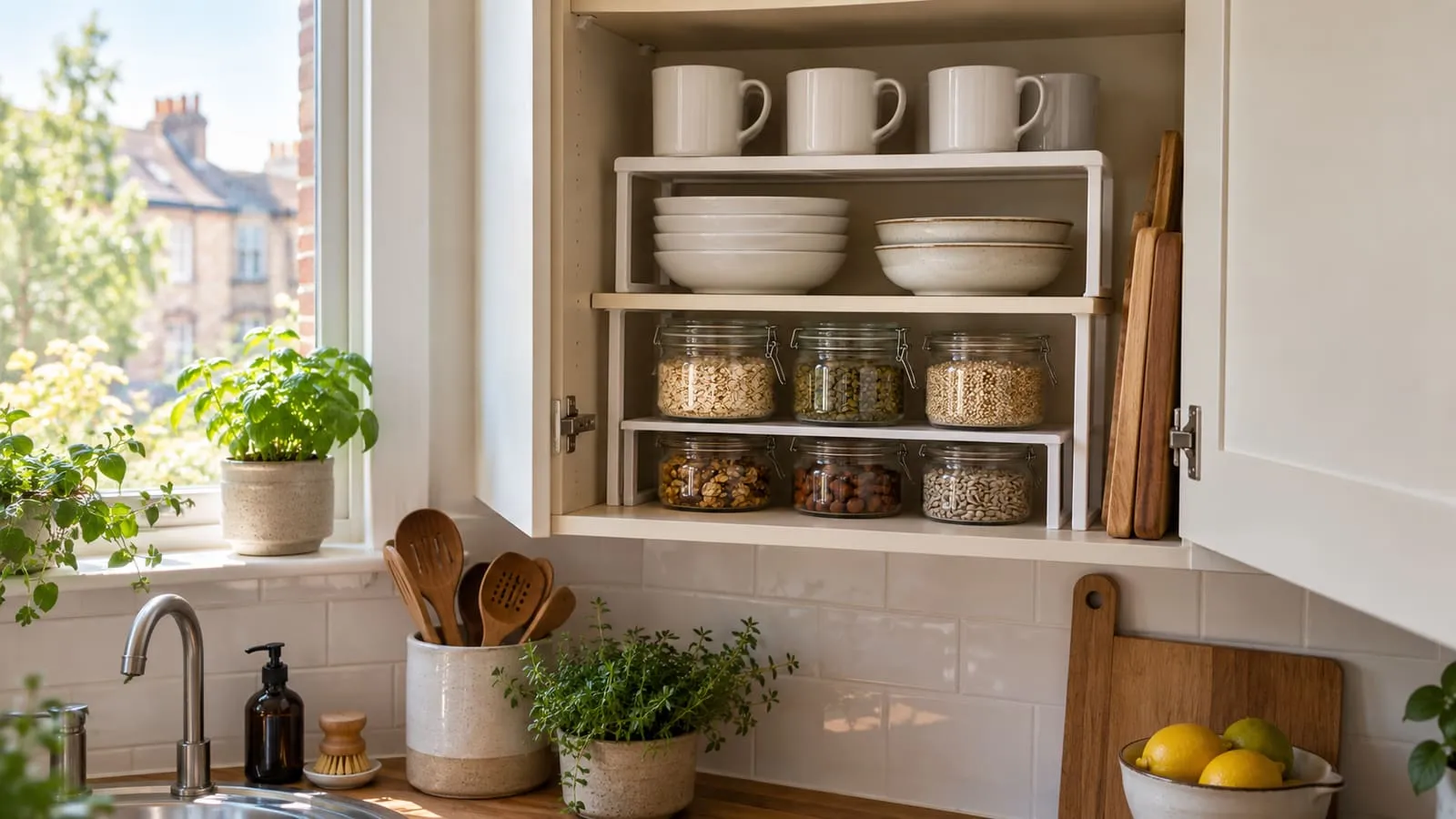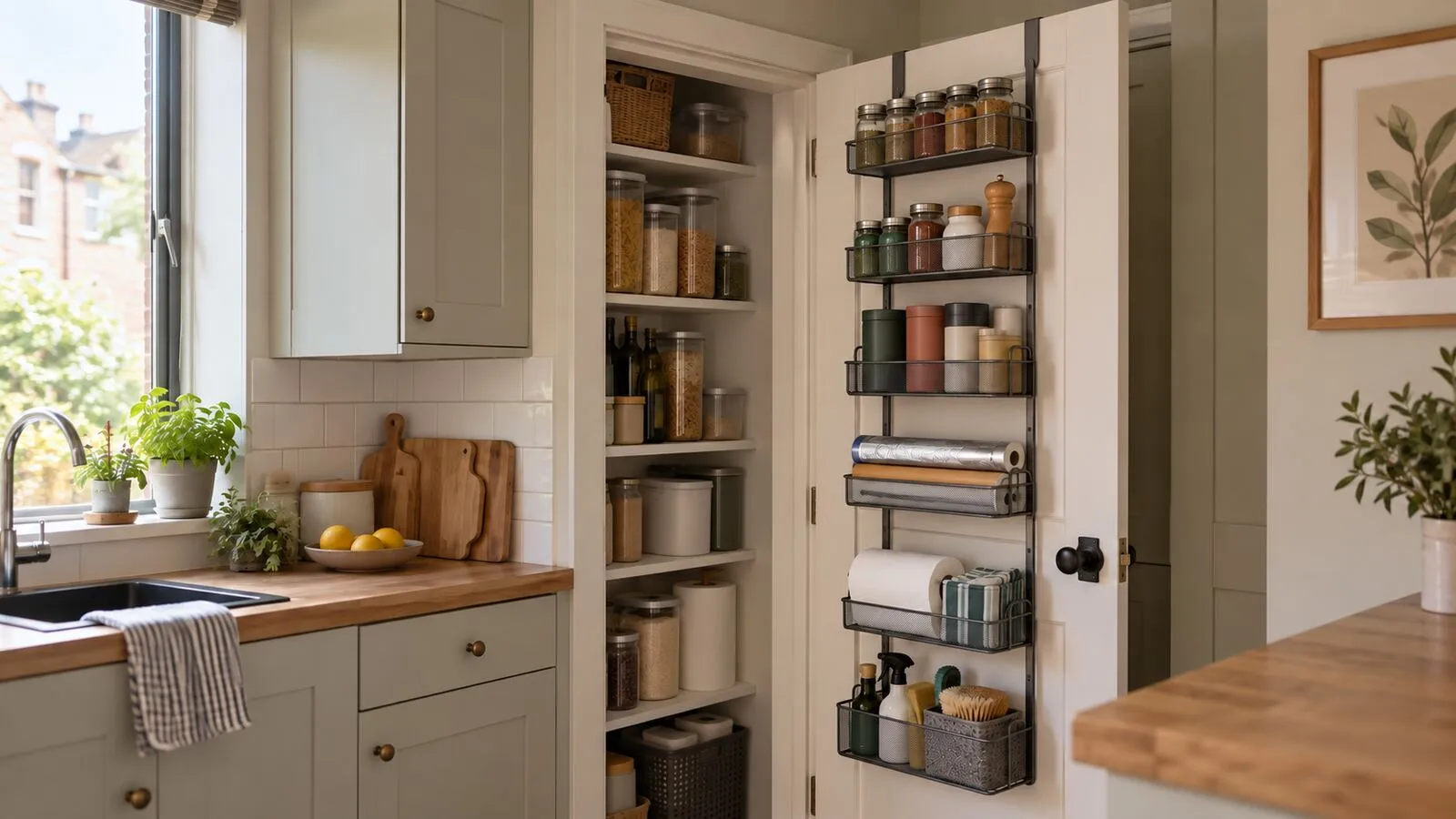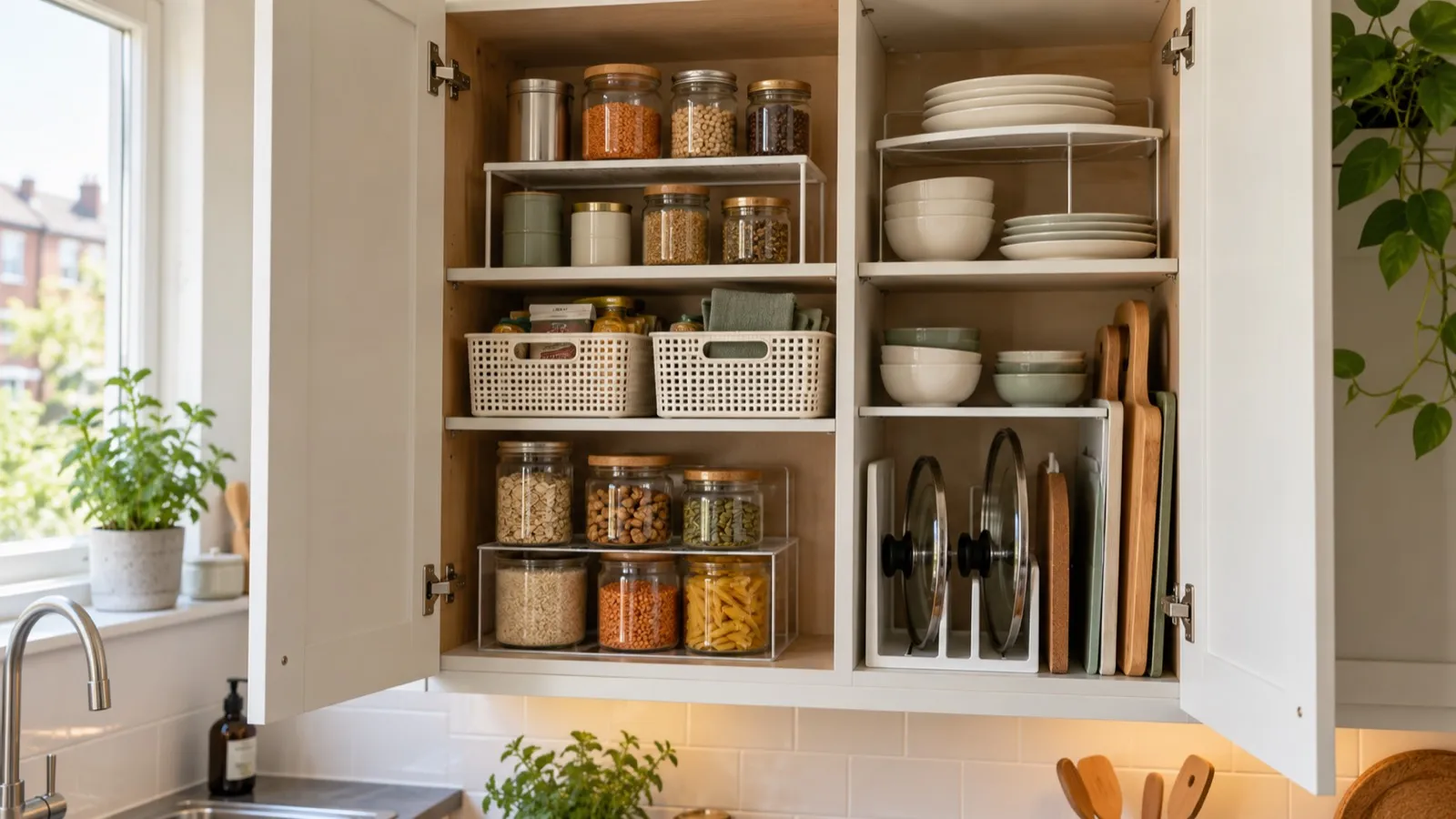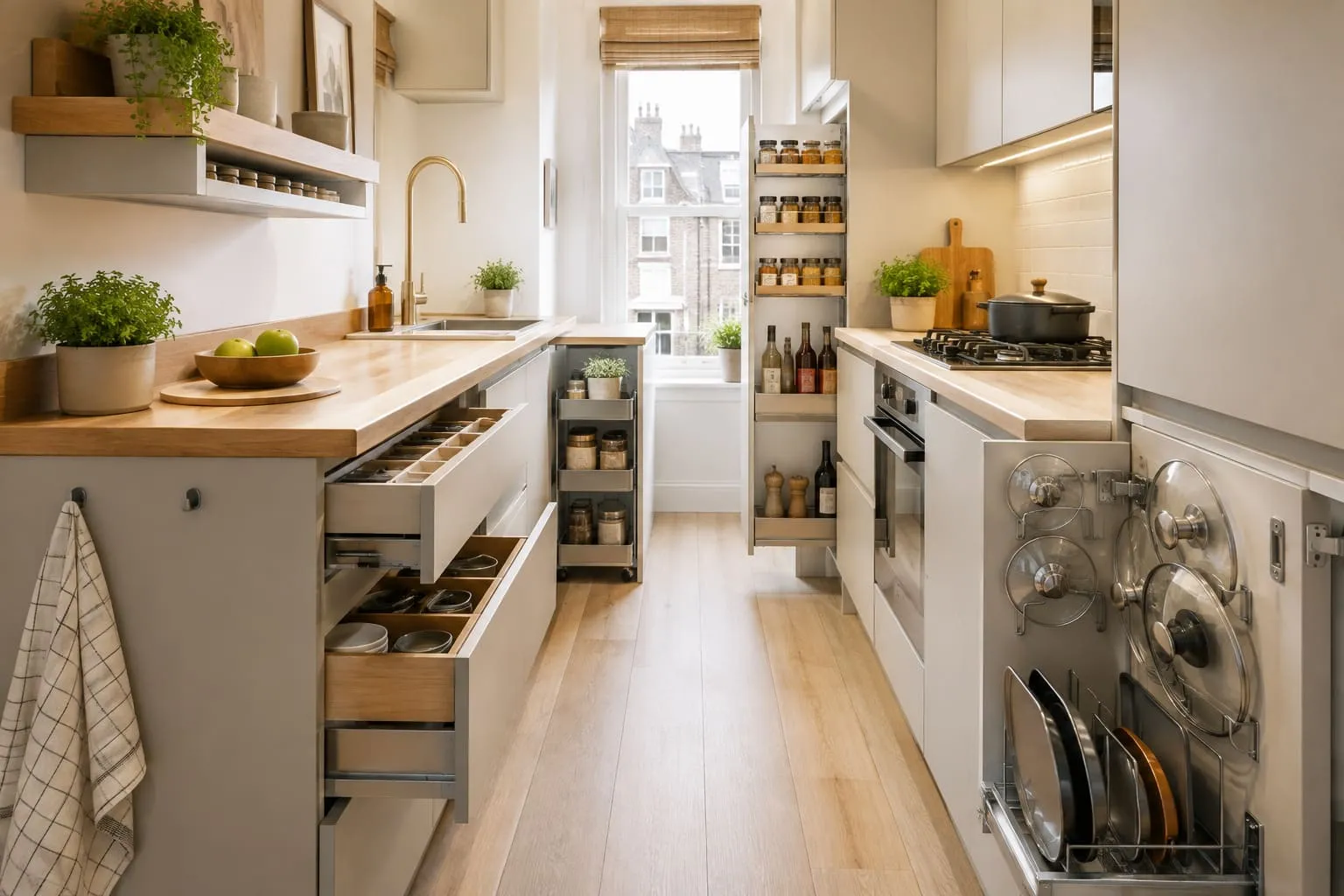
A galley kitchen rarely has a shortage of walls. What it lacks is spare width. Add a bulky cabinet, deep trolley or countertop rack and you can create more storage on paper while making the kitchen worse to cook in.
The best kitchen storage for galley kitchens works in the opposite direction. It uses the height inside cupboards, the backs of suitable doors, the depth of drawers and those awkward gaps that are already too narrow to be useful. The aim is not to fill every centimetre. It is to make more of what you already have without shrinking the aisle or sacrificing prep space.
If you have a genuine 13–15cm dead gap, the VASAGLE 4-Tier Slim Kitchen Trolley is our most useful single addition. If you do not, start inside the cabinets instead. A compact cutlery organiser, under-shelf drawer or pull-out cupboard tray can often make a bigger difference because it adds access and capacity without putting another object in the room.
Our quick picks
- Best overall for a dead narrow gap: VASAGLE 4-Tier Slim Kitchen Trolley
- Best for a cramped cutlery drawer: Joseph Joseph DrawerStore Compact Cutlery Organiser
- Best for unused shelf height: Joseph Joseph CupboardStore Under-Shelf Drawer
- Best for deep base cupboards: Hovoto Pull Out Cabinet Organiser
- Best budget cupboard organiser: Copco Basics 3-Tier Spice Rack
- Best for pan lids: Joseph Joseph Duo Set of 3 Pot & Pan Lid Holders
The galley-kitchen rule: add storage without shrinking the aisle
Galley kitchens are efficient because everything is close. That advantage disappears quickly if new storage projects into the route between the two runs of cabinets.
Before buying anything freestanding, ask where it will sit when you are actually cooking. If you have to turn sideways around it, move it to open an oven door or shift it every time two people use the kitchen, it is not really solving a storage problem.
Treat the walkway as protected space
The aisle is part of the kitchen’s working area. Protect it first. A slim trolley only makes sense when it lives in a dead strip beside a cabinet, at the end of a run or in another recess that was not useful for standing or moving.
The same principle applies to bins, stools and freestanding shelving. Measure them in their normal position, with doors and drawers open nearby, rather than judging them by product width alone.
Measure internal clearances, not just cabinet width
Cupboard organisers often fail because the nominal cabinet size is not the usable size. Hinges, pipes, shelf supports and door frames can all reduce the clear space.
For drawers, measure internal width, depth and height. For base cupboards, check the clear opening as well as the depth. For anything mounted on a door, close the door with the intended item held in position first so you know it will not hit a shelf.
Use the worktop as worktop
A countertop organiser can make clutter look tidier while still occupying the exact surface you need for chopping, draining and serving. In a narrow kitchen, that is usually a poor trade.
Whenever possible, move everyday categories into a drawer or cupboard and keep the worktop for the small number of items you genuinely use every day.
1. VASAGLE 4-Tier Slim Kitchen Trolley — best overall for a dead narrow gap

VASAGLE
VASAGLE 4-Tier Slim Kitchen Trolley
LRC032W09
Editorial reviewAssessed from specifications, reporting and comparable products — not a long home trial. How we test
This is the product we would look at first only if your kitchen has a real unused sliver of floor space. At 13cm deep, the VASAGLE trolley can fit places where conventional shelving is not an option, such as a gap at the end of a cabinet run or beside an appliance where the manufacturer’s required clearances are still maintained.
The four open tiers are useful for bottles, tins, packets, cling film and other pantry items that do not need a full-depth cupboard. Because the trolley is on swivel castors, you can pull it out instead of reaching into a narrow slot.
That mobility is what makes it more practical than simply stacking items in the gap. It can also be moved for cleaning, which matters in a kitchen where crumbs and dust quickly collect beside cabinets.
The important caveat is that 13cm is not a reason to squeeze it into every possible space. Check skirting boards, cabinet handles and appliance doors at several heights. If the trolley would sit partly in the walkway, skip it and spend the money on internal organisers instead.
Best for: Galley kitchens with a genuinely dead 13–15cm gap that can become pantry storage without reducing circulation.
2. Joseph Joseph DrawerStore Compact Cutlery Organiser — best for a cramped cutlery drawer
Joseph Joseph
Joseph Joseph DrawerStore Compact Cutlery Organiser
DrawerStore Compact Cutlery Organiser
Editorial reviewAssessed from specifications, reporting and comparable products — not a long home trial. How we test
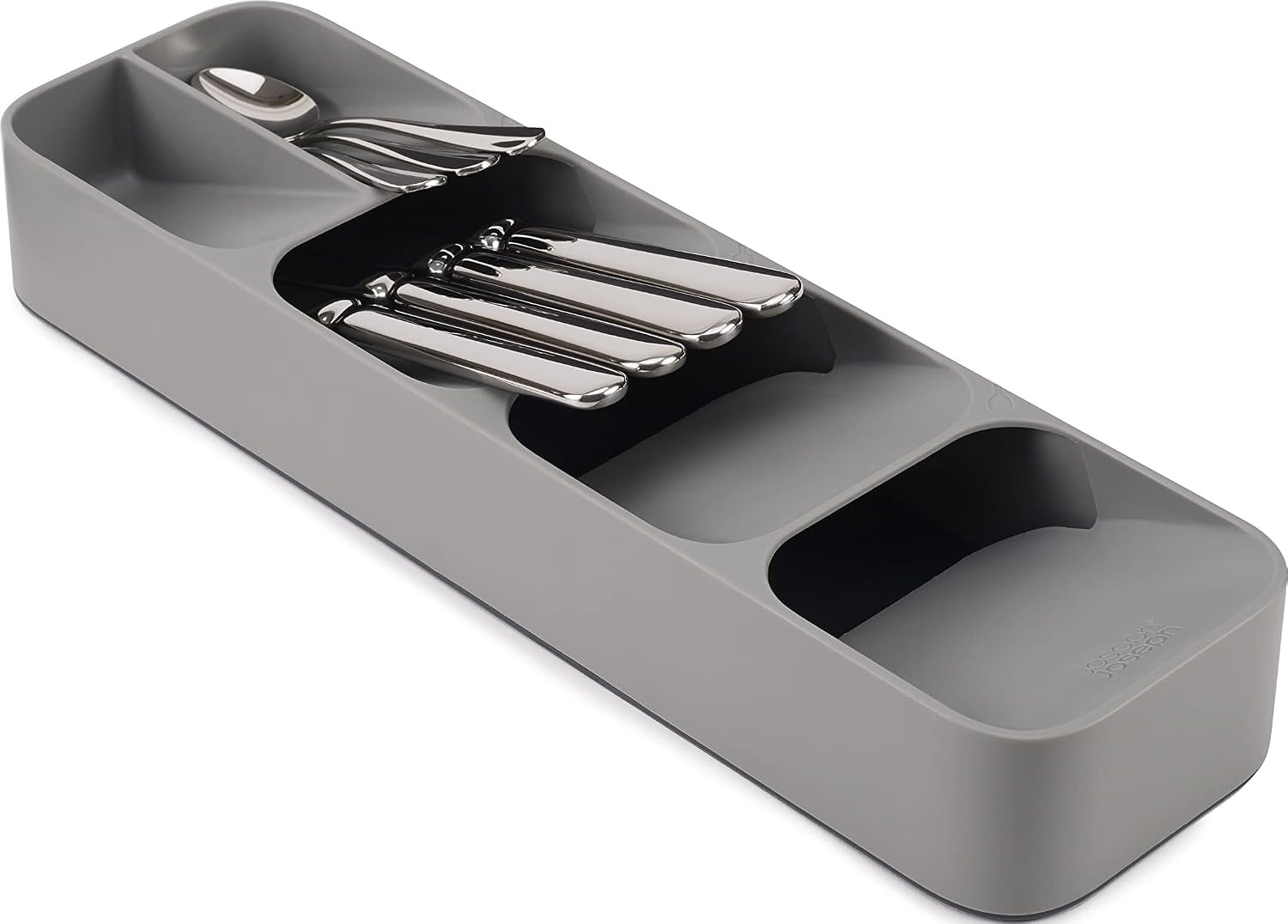
A standard cutlery tray spreads knives, forks and spoons side by side. That is simple, but it can consume almost the whole width of a small drawer. DrawerStore takes a different approach by overlapping five cutlery compartments in a compact row.
That makes it especially useful in a galley kitchen where one drawer may need to hold cutlery and leave room for another organiser beside it. It is designed for more than 24 pieces, with icons that make the stacked compartments easier to identify at a glance.
The trade-off is height. Joseph Joseph specifies a minimum drawer height of 8cm, so measure the internal clearance rather than the drawer front. It is also a cutlery solution, not a home for whisks, spatulas and long knives; those still need their own zone.
If your problem is a drawer that feels wide but somehow has no spare room, this is one of the few organisers that can genuinely reduce the footprint of the category rather than merely subdividing it.
Best for: Narrow or overloaded cutlery drawers where reclaiming horizontal width is more valuable than having a conventional flat tray.
3. Joseph Joseph CupboardStore Under-Shelf Drawer — best for unused shelf height

Joseph Joseph
Joseph Joseph CupboardStore Under-Shelf Drawer
CupboardStore Under-Shelf Drawer
Editorial reviewAssessed from specifications, reporting and comparable products — not a long home trial. How we test
Tall kitchen cupboards often waste a band of space directly underneath the shelf above. CupboardStore converts some of that empty height into a small pull-out drawer for light items such as stock cubes, sachets, tubes and small packets.
This is exactly the kind of storage that suits a galley kitchen: it works inside the existing cabinet envelope. Nothing moves into the aisle, and you do not lose worktop space.
The dimensions matter. The unit is about 23.5cm wide and is intended for shelves no thicker than 2cm. It uses 3M VHB adhesive rather than screws, so installation is straightforward, but you should still check that the shelf finish is suitable and that you are comfortable using strong adhesive there.
Also look at what will sit underneath the new drawer. You gain a small compartment but lose some vertical clearance on the shelf below, so it is most effective above tins, jars or other shorter items rather than tall cereal boxes or bottles.
Best for: Cupboards with unused air beneath a shelf and lots of small packets that otherwise end up in a messy pile.
4. Hovoto Pull Out Cabinet Organiser — best for deep base cupboards

Hovoto
Hovoto Pull Out Cabinet Organiser
Adjustable No-Drill Pull Out Cabinet Organiser
Editorial reviewAssessed from specifications, reporting and comparable products — not a long home trial. How we test
Deep base cupboards can hold plenty and still feel useless because the items at the back are difficult to reach. A pull-out organiser changes the problem from “how much fits?” to “how easily can I get to it?”
The Hovoto is a no-drill pull-out tray with a listed adjustable size range that extends to suit deeper cupboards. Rather than crouching down and removing the front row, you pull the tray towards you and bring its contents into the doorway.
That can work well for oils, sauces, tins and other medium-weight cupboard staples. It is also helpful if you repeatedly buy duplicates because you cannot see what is hiding at the back.
Measure carefully before ordering. The cabinet’s clear opening can be narrower than its internal width because of hinges and the door frame. You also need a clean, flat base for a no-drill fitting to work as intended.
Best for: Deep lower cupboards where access, rather than theoretical capacity, is the main reason the space feels inefficient.
5. Copco Basics 3-Tier Spice Rack — best budget cupboard organiser

Copco
Copco Basics 3-Tier Spice Rack
Basics 3-Tier Spice Rack
Editorial reviewAssessed from specifications, reporting and comparable products — not a long home trial. How we test
Not every galley-kitchen fix needs moving parts or adhesive. Sometimes the problem is simply that a cupboard is deep enough to create two or three rows of jars, and the back rows disappear.
The Copco rack raises those rear rows on three steps. It does not magically create more shelf depth, but it makes the depth usable because you can see labels and reach the jar you want without taking everything out first.
Its freestanding design is also useful in rentals. There is nothing to drill or stick down, and you can move the organiser to another shelf if your setup changes.
The main constraint is vertical space. A stepped rack needs enough headroom above the back row, so check the shelf spacing before buying. It makes most sense for spices, small tins and packets rather than tall oil bottles.
Best for: Anyone who wants a low-cost cupboard upgrade that improves visibility without committing to permanent fittings.
6. Joseph Joseph Duo Set of 3 Pot & Pan Lid Holders — best for pan lids

Joseph Joseph
Joseph Joseph Duo Set of 3 Pot & Pan Lid Holders
Duo Set of 3 Pot & Pan Lid Holders
Editorial reviewAssessed from specifications, reporting and comparable products — not a long home trial. How we test
Pan lids consume an awkward amount of space because they are wide, shallow and rarely stack neatly. The Duo holders move three lids out of a drawer or cupboard and onto an unused vertical surface, typically the inside of a suitable cupboard door.
Each holder is self-adhesive and designed for lids roughly 16–24cm in diameter. Because the three pieces are separate, you can position them around hinges rather than committing to one large rack.
This is a good example of galley-kitchen storage that adds capacity by using a surface you already own. But door-mounted storage always needs a dry run: hold the lid against the planned position, close the door gently and make sure it clears the shelf and anything stored inside.
Three holders will not solve a large cookware collection, and adhesive mounting will not be right for every cabinet finish. For a small set of everyday pans, though, it can free a surprisingly useful amount of drawer space.
Best for: Small cookware collections where three frequently used lids are taking up disproportionate drawer or shelf space.
Choose storage by the bottleneck, not the product
A small kitchen gets cluttered fastest when every problem is answered with another organiser. Instead, identify what is actually limiting you.
You have one narrow dead gap
Measure it at floor, worktop and handle height. If there is enough clear space and it is not needed for ventilation or movement, a slim trolley can turn the gap into a pantry. If it intrudes into the aisle, leave the gap alone.
Your drawers are full but your cupboards are not
Reduce the footprint of drawer categories first. A compact cutlery organiser can release width, while moving suitable pan lids onto a door can free a deeper drawer for utensils or pans.
Your cupboards are tall but half-empty above the contents
Use that vertical air. An under-shelf drawer can create a new shallow layer for packets, while a tiered rack makes better use of the height at the back of a shelf.
You cannot reach the back of a base cupboard
Do not add more shelves until access is fixed. A pull-out tray or removable bin lets the contents come to you, which often makes the existing cupboard feel larger because fewer things are forgotten behind the front row.
What we would not buy first for a galley kitchen
A few storage products look useful online but are poor first choices in a genuinely narrow kitchen.
Deep freestanding carts are the obvious example. They can add shelves while permanently stealing from the aisle. Unless the cart sits at the end of a run or inside a recess, internal storage is usually the better first move.
We would also avoid covering a small worktop with tiered racks, mug trees and freestanding baskets just because they are marketed as space-saving. They organise the surface; they do not give the surface back to you.
Door-mounted systems deserve care too. They can be excellent, but only after you have checked hinges, shelf positions, handles and closing clearance. A storage idea that stops the cupboard closing is not a storage upgrade.
Finally, resist buying a complete matching organiser system before you know which zone is actually failing. Galley kitchens reward precise fixes more than large collections of containers.
A 20-minute galley-kitchen storage reset before you buy anything
Start by taking everything off the worktop that is not used every day. Put those items into rough groups: daily, weekly and occasional.
Next, open each cupboard and drawer and look for four types of wasted space: an unused narrow gap, excess height above short items, inaccessible depth at the back of a base cupboard, and categories that occupy more drawer width than they need.
Measure only the worst one or two zones. Include internal height, hinge intrusion and door clearance rather than writing down the cabinet’s external size.
Then buy the smallest organiser that solves that specific problem. Live with it for a few days before adding another. This approach is less satisfying than ordering an entire storage set in one go, but it usually leaves a small kitchen calmer and more flexible.
Our final recommendation
For most galley kitchens, the best storage upgrade is not another piece of furniture. Start inside the cupboards and drawers, where you can gain capacity without making the room physically narrower.
If you do have a genuine unused 13cm-plus strip, the VASAGLE 4-Tier Slim Kitchen Trolley is our best overall pick because it turns dead space into accessible pantry storage. Otherwise, choose the organiser that matches your worst bottleneck: DrawerStore for a cramped cutlery drawer, CupboardStore for unused shelf height, Hovoto for inaccessible cupboard depth, Copco for hidden jars and Duo holders for unruly pan lids.
The most successful galley kitchen is not the one with the most storage products. It is the one where the things you use most are easy to reach and the aisle and worktop still feel clear.