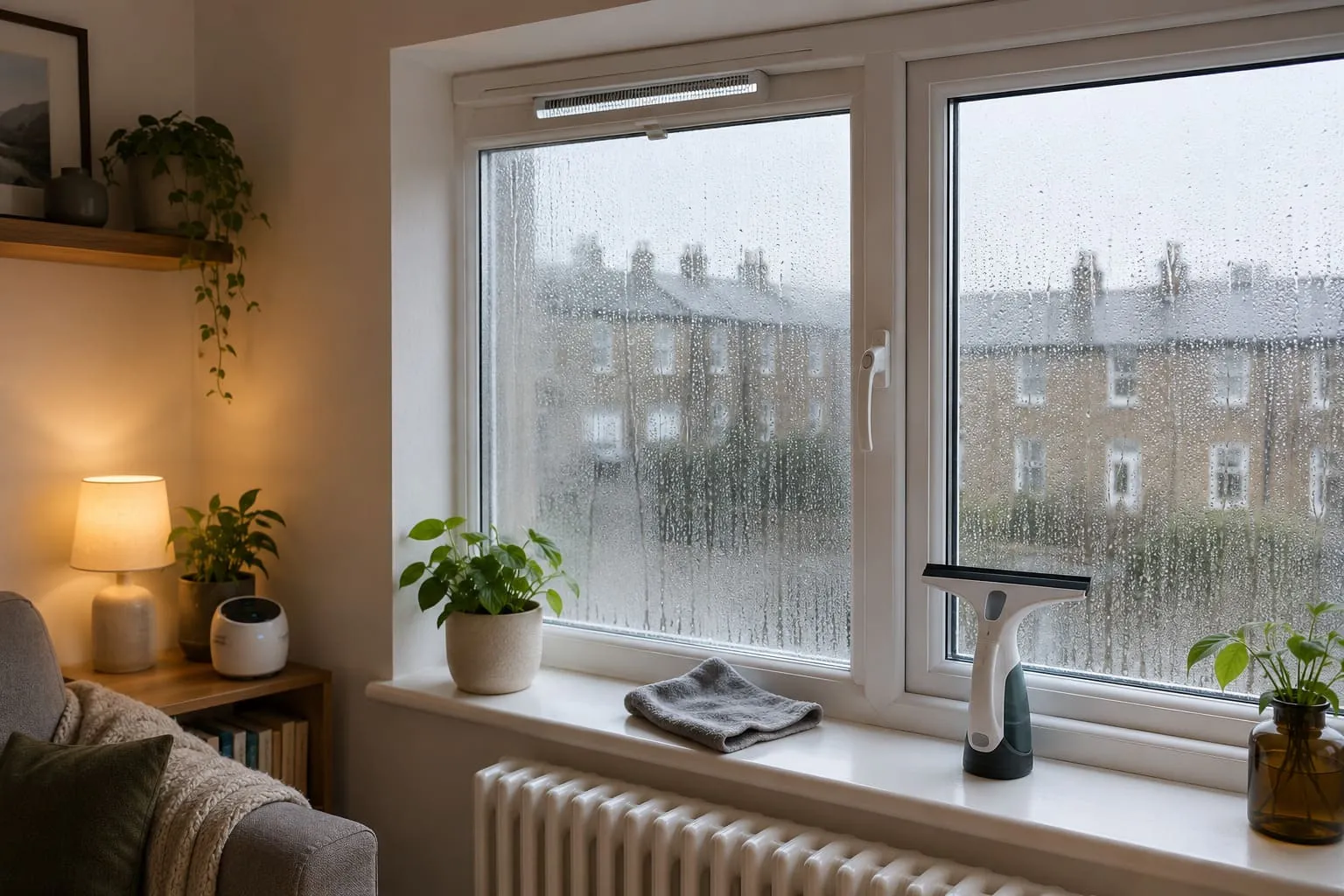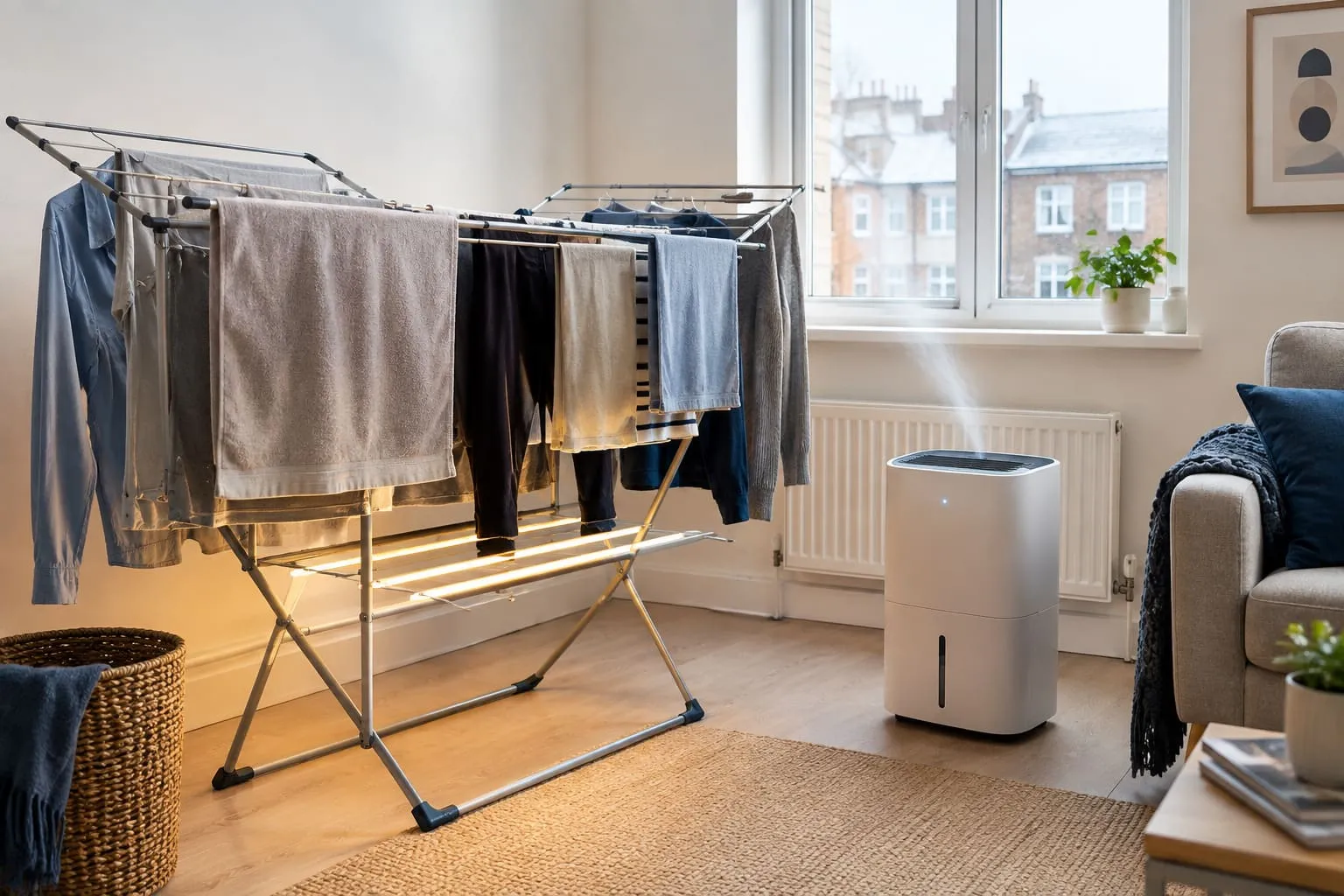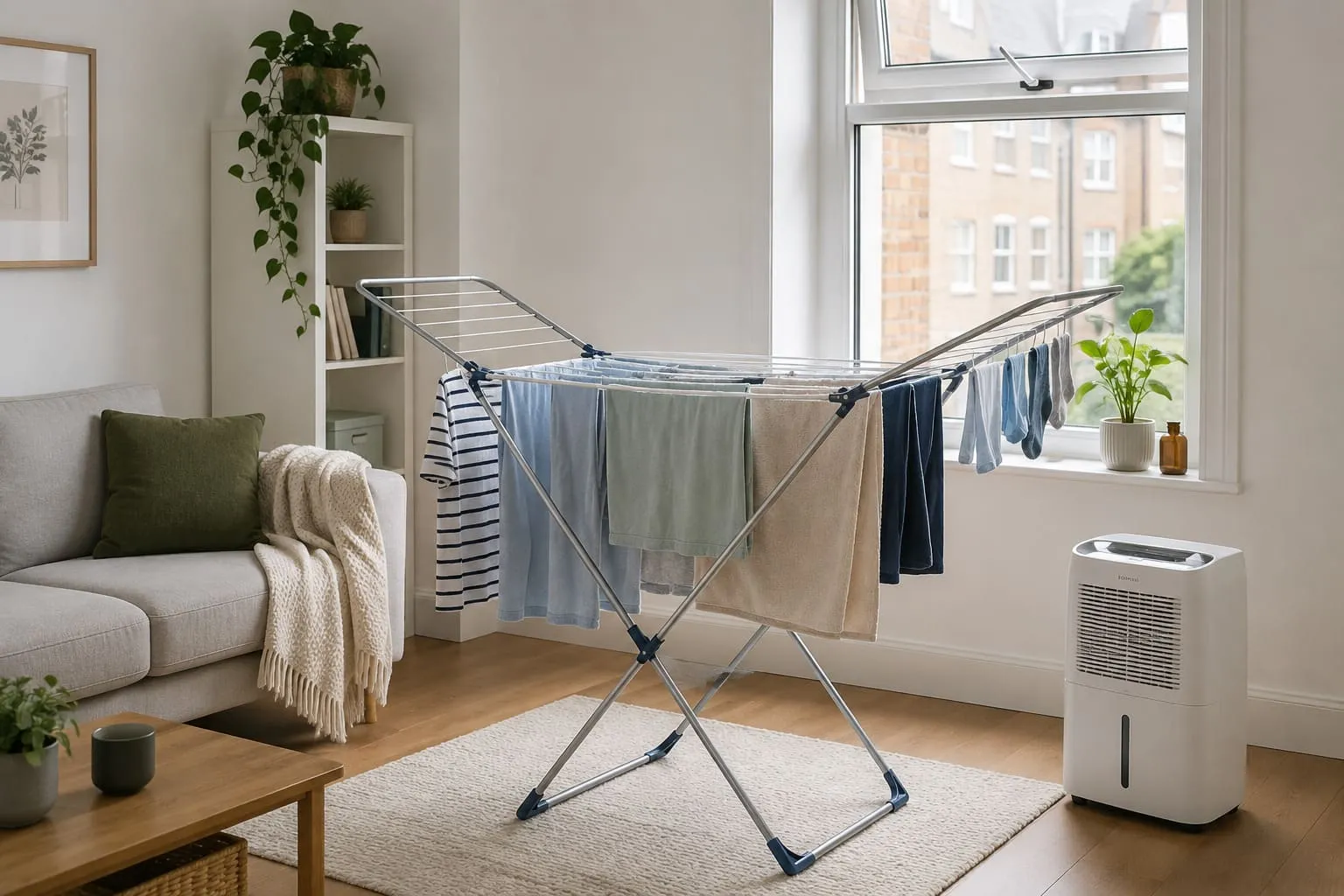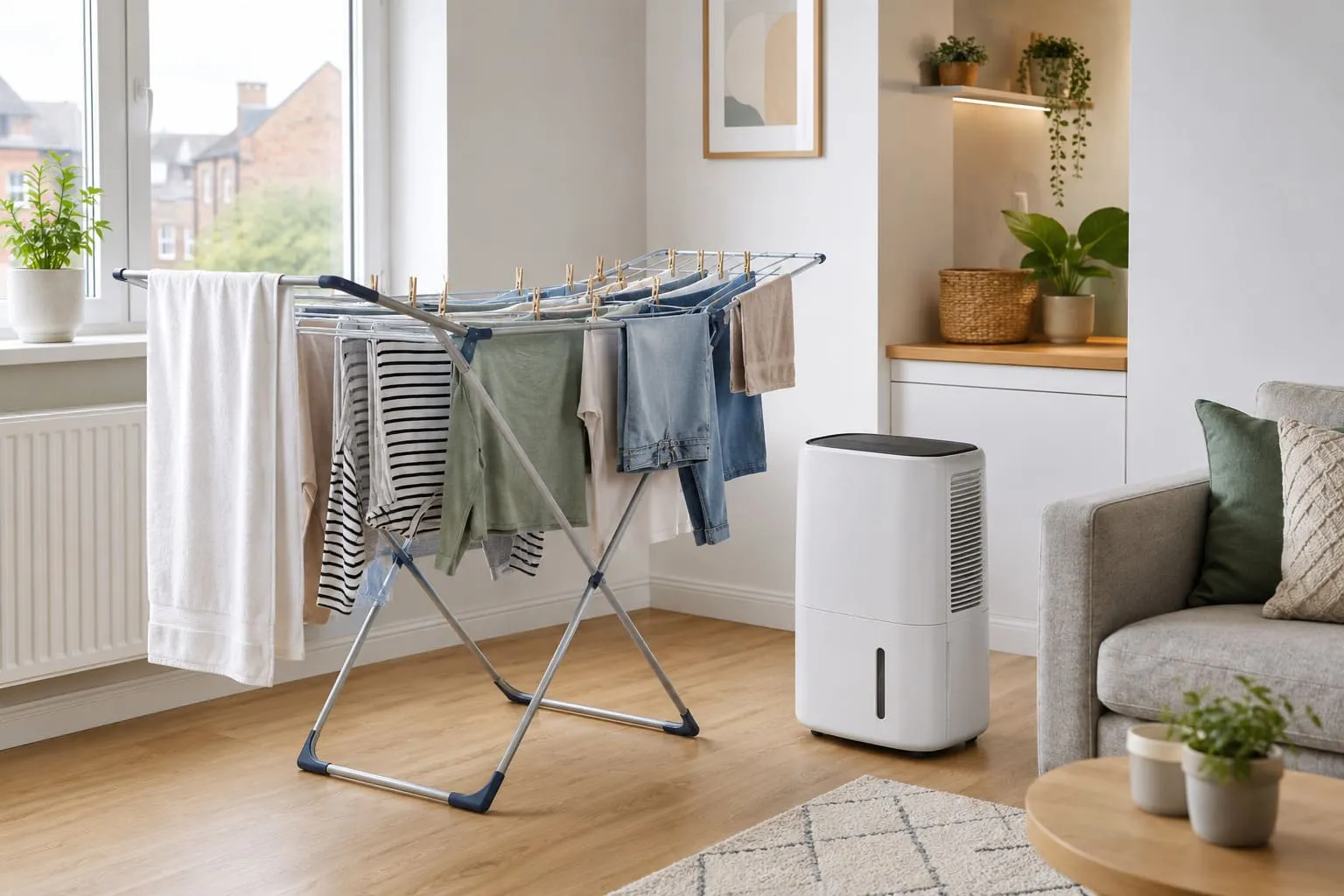
Drying clothes indoors is not just a speed problem in a UK flat. Every wet load releases water into the room, and if that moisture has nowhere to go it can end up on windows, cold external walls and other surfaces. The best dehumidifier for drying clothes therefore needs to do more than show a big litre-per-day number: it needs sensible laundry airflow, a useful tank, manageable running costs and the right technology for the temperature of the room.
For most small and medium flats, our first choice is the MeacoDry Arete Two 12L. It is a compact compressor dehumidifier with a dedicated laundry mode, three fan speeds and a rated power draw of 136W. That combination makes more sense for repeated laundry days than buying the highest-capacity machine you can physically fit beside the airer.
If you are drying for a family or regularly hang several bulky loads, move up to the Pro Breeze PB-D-23 20L. If the clothes live in a cold conservatory, unheated utility room or chilly spare room, the EcoAir DD1 Classic MK6 is the more relevant comparison because its desiccant system is designed to keep working in low temperatures.
Our quick picks
- Best overall for small flats: MeacoDry Arete Two 12L
- Best for bigger laundry loads: Pro Breeze PB-D-23 20L
- Best for cold rooms: EcoAir DD1 Classic MK6
- Best simple 12L alternative: De’Longhi Tasciugo AriaDry DEX212SF
What matters when drying clothes with a dehumidifier
Laundry mode should change how the machine behaves
A useful laundry mode is not just a different icon on the control panel. Wet clothes create a temporary spike in humidity, so the dehumidifier needs to keep pulling water from the air while moving enough dry air through the room to help evaporation continue.
For that reason, we favour models that combine continuous or extended dehumidification with stronger fan airflow. An adjustable louvre is useful because the dry outlet air can be directed across the airer rather than straight into an empty corner.
The aim is not to point the machine centimetres from wet fabric. Give it the clearances required in the manual and think about air circulation around the whole rack.
Extraction rate matters, but room temperature changes the answer
A 20L compressor dehumidifier sounds automatically better than a 12L model, but the headline rating is measured under controlled test conditions. Real extraction in a cooler UK bedroom can be much lower.
For a normally heated flat, a good 10-12L compressor model is often enough for one airer and everyday humidity control. A 20L unit earns its extra size when you have bigger loads, more people, a larger drying room or persistent moisture problems beyond laundry.
Cold rooms are different. Compressor dehumidifiers become less effective as the air gets colder, which is why a desiccant model such as the EcoAir DD1 can be worth its higher power use in a conservatory, garage or unheated utility room.
Tank size matters more on laundry day
A small tank is manageable when a dehumidifier is only trimming normal household humidity. A load of wet washing can fill it much faster.
The Meaco’s 2.5L tank is reasonable for its compact size, while the Pro Breeze has a much larger 5.5L tank. If you regularly run a machine for long periods, also check whether continuous drainage is practical in the room where you dry clothes.
Do not choose on tank size alone. A huge tank attached to an oversized machine is not automatically a better fit for a one-bedroom flat where the dehumidifier has to be stored between uses.
Running cost is power multiplied by time
For repeated laundry drying, rated wattage is worth noticing. The MeacoDry Arete Two 12L is rated at 136W, while the EcoAir DD1 Classic can use considerably more power because a desiccant rotor works differently from a compressor system.
That does not make desiccant technology bad. It means you should buy it for the right reason: reliable low-temperature performance. In a heated living space, a modern compressor dehumidifier is usually the more economical starting point.
1. MeacoDry Arete Two 12L — best overall for small flats

Meaco
MeacoDry Arete Two 12L Dehumidifier & Air Purifier
MeacoDry Arete Two 12L
Editorial reviewAssessed from specifications, reporting and comparable products — not a long home trial. How we test
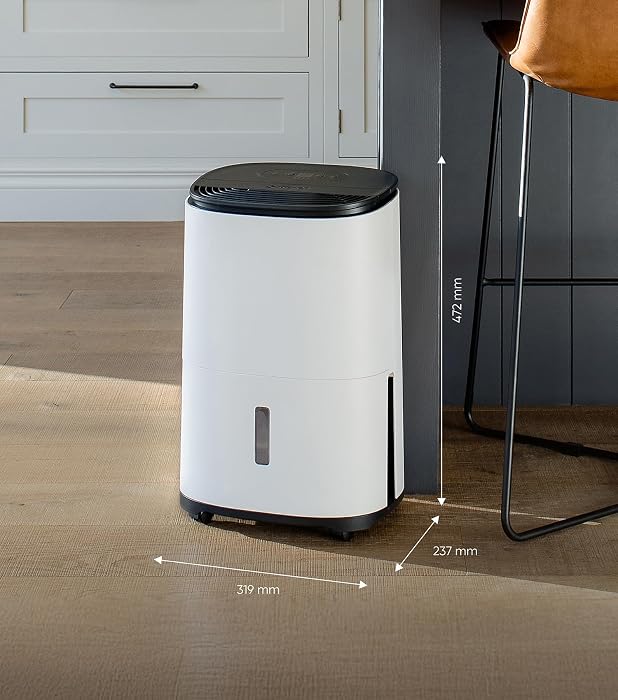
The MeacoDry Arete Two 12L is the model we would start with for a typical one- or two-bedroom UK flat. It combines a 12L/day maximum extraction rating with a 2.5L tank, a compact body around 23.7 x 31.9 x 47.2cm and a low 136W rated power draw.
For laundry, the important part is the control you get over airflow. There is a dedicated laundry setting, three fan speeds and an adjustable louvre, so you can encourage dry air to move through a rack rather than relying on passive circulation. It is also quiet enough on its lower settings to make sense in a home where the drying room is also a bedroom, office or living space.
The Arete Two is not the cheapest way to buy 12L of headline extraction. You are paying for refinement: quieter operation, lower power use, smart controls and HEPA filtration alongside the dehumidifier. If all you want is maximum litres per pound, a simpler model can cost less.
For a small home, however, the balance is strong. A dehumidifier that is cheap to buy but bulky, noisy or expensive enough to discourage regular use is not much of a laundry solution.
Best for: one- and two-person households drying clothes regularly in a normally heated flat.
2. Pro Breeze PB-D-23 20L — best for bigger laundry loads

Pro Breeze
Pro Breeze 20L/Day Compressor Dehumidifier
PB-D-23
Editorial reviewAssessed from specifications, reporting and comparable products — not a long home trial. How we test
The Pro Breeze PB-D-23 is the step-up choice when a 12L machine feels undersized. Its maximum extraction rating is 20L/day and the water tank holds 5.5L, so it is better suited to larger loads and longer laundry sessions without repeated emptying.
That extra capacity is useful for couples who wash frequently, families drying school uniforms and towels, or anyone who wants one dehumidifier to tackle both laundry and a broader damp problem. The dedicated laundry mode, humidity sensor and continuous-drain option make it easy to use for extended drying sessions.
You do pay for the capacity in physical size. At roughly 60.8cm high and around 35.5cm across its deeper side, this is more appliance than the Meaco 12L. It also has a higher rated power draw, so buying it for occasional small loads would be unnecessary.
If your problem is that one airer never seems to finish before the next wash is ready, though, the larger compressor gives you more headroom without moving into specialist desiccant territory.
Best for: bigger households, heavier wash loads and larger drying rooms where 20L-class extraction is worth the extra size.
3. EcoAir DD1 Classic MK6 — best for cold rooms

EcoAir
EcoAir DD1 Classic MK6 Desiccant Dehumidifier
DD1 Classic MK6
Editorial reviewAssessed from specifications, reporting and comparable products — not a long home trial. How we test
The EcoAir DD1 Classic MK6 is here for a different reason from the three compressor models. It is a desiccant dehumidifier, so it is far less dependent on a warm room to work effectively. EcoAir rates it for operation down to about 1°C, which makes it a much better match for a cold conservatory, utility room or spare room that is not heated like the rest of the flat.
Its laundry mode combines dehumidification with a 3D louvre and warm dry outlet air. That warmth is particularly useful in winter because it helps raise the local drying temperature while moisture is being removed. At around 6kg, the DD1 is also relatively easy to carry to whichever room is doing laundry duty.
The trade-off is electricity use. EcoAir lists about 300W on low and 580W on high, substantially more than an efficient 12L compressor model in normal indoor conditions. The 2L tank is also small for heavy laundry unless continuous drainage is convenient.
This is therefore not our default recommendation for a heated flat. It is the specialist pick when the room itself is cold enough to make compressor performance the bigger compromise.
Best for: cold bedrooms, conservatories and unheated utility spaces where clothes take forever to dry in winter.
4. De’Longhi Tasciugo AriaDry DEX212SF — best simple 12L alternative

De'Longhi
De'Longhi Tasciugo AriaDry DEX212SF 12L Dehumidifier
DEX212SF
Editorial reviewAssessed from specifications, reporting and comparable products — not a long home trial. How we test
The De’Longhi Tasciugo AriaDry DEX212SF is a straightforward alternative if you want a familiar 12L compressor format without making app control part of the buying decision. It has a dedicated laundry function, a 2.1L tank and a slim body that is only about 22cm deep.
That shallow depth is useful in a smaller bedroom or box room where a wide appliance quickly gets in the way. De’Longhi also combines dehumidification with a three-action filtration system, so the machine can keep doing useful work outside laundry sessions.
Its main weakness against the Meaco is efficiency on paper. The DEX212SF is rated at 300W, and its 2.1L tank is slightly smaller. If you run a dehumidifier for several hours every week to dry washing, those practical differences matter more than a long feature list.
Choose it when you value simple controls, a slim case and a dedicated laundry programme more than smart-home extras.
Best for: buyers who want a simple, compact 12L laundry dehumidifier from an established appliance brand.
Which capacity is right for laundry?
10-12L: the sensible starting point for a small heated flat
For one clothes airer in a studio, one-bedroom or modest two-bedroom flat, a good 10-12L compressor dehumidifier is usually the right place to start. It is easier to store, easier to move and normally consumes less power than a bigger machine.
Do not interpret 12L/day as a promise that the machine will pull 12 litres from your room every 24 hours. It is a standardised maximum extraction figure. Real performance depends heavily on temperature and relative humidity.
20L: useful when the laundry itself is the bottleneck
Move to a 20L model if you routinely dry full family loads, run more than one airer, have a larger room or want the dehumidifier to deal with persistent damp beyond laundry. The larger compressor and fan can process more moist air, while a bigger tank is convenient during long sessions.
The penalty is obvious in a small home: more appliance to store and more floor space occupied while it runs.
Desiccant: choose it for temperature, not the litre number
A desiccant dehumidifier can have a lower headline extraction figure yet outperform a compressor unit in a very cold space. That is because the technologies respond differently to temperature.
If you dry clothes in a room that stays comfortably heated, we would usually choose a compressor model. If you deliberately keep the drying room cold to save on heating, a desiccant model deserves a much closer look.
How to dry clothes faster with a dehumidifier
Start before the dehumidifier is switched on. Use the fastest sensible spin cycle for the fabric so the washing machine removes as much water as possible first. Then hang clothes with gaps rather than packing the airer until every rail disappears.
Put the airer and dehumidifier in the smallest practical room you can close off. A bedroom or utility room is easier for the machine to control than an open-plan flat with doors and windows open. Position the dry-air outlet so it encourages circulation through the rack, while respecting the clearances in the manufacturer’s instructions.
During active drying, keep the room closed rather than continuously opening a window. The point of the dehumidifier is to capture the water leaving the clothes; an open window can make it spend energy processing incoming outside air as well. Once the load is dry, return the flat to your normal ventilation routine.
For a fuller moisture-control method, see how to dry clothes in a flat without a tumble dryer.
Dehumidifier vs heated airer
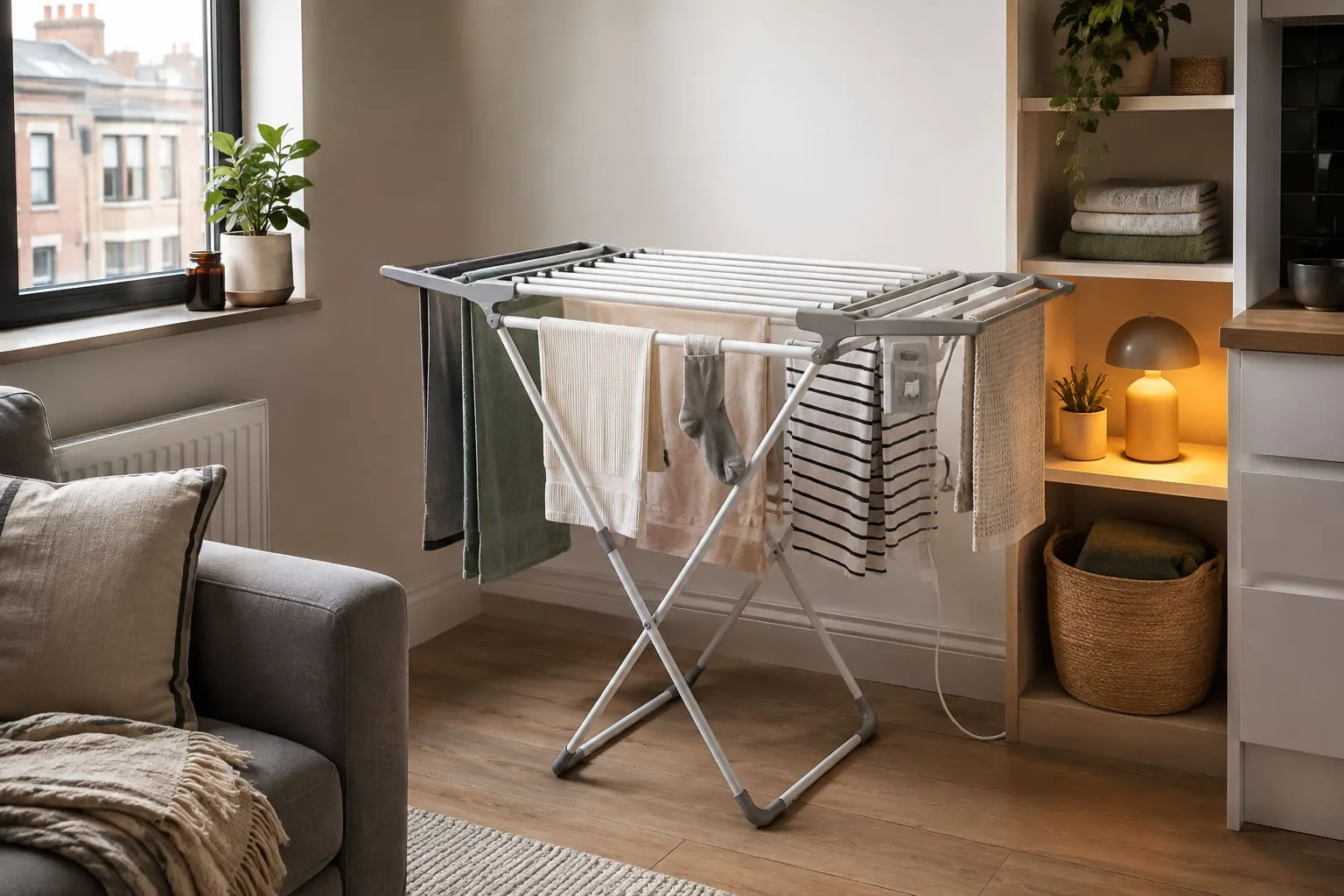
A dehumidifier and a heated airer solve opposite halves of the same problem. The heated airer adds warmth to help water leave the clothes. The dehumidifier removes that water from the air.
If your windows already stream with condensation, the dehumidifier is usually the more important first purchase because it tackles the room moisture as well as drying speed. If humidity is under control and the only problem is that thick items stay cold and damp for too long, a heated airer can be the more direct upgrade.
Using both can work well. The heated airer accelerates evaporation and the dehumidifier captures the released moisture, which is why the combination is popular in flats without a tumble dryer. See our best heated airers for small flats if you are building that setup.
Our final recommendation
For most small UK flats, buy the MeacoDry Arete Two 12L. The 12L capacity is sensible for one-airer laundry, the 136W rated power keeps repeated use reasonable, and the laundry mode gives you the stronger airflow that wet washing actually needs.
Choose the Pro Breeze PB-D-23 20L when the volume of washing is the problem and you have room for a larger machine. Choose the EcoAir DD1 Classic MK6 when the drying space is genuinely cold. The De’Longhi DEX212SF is the straightforward alternative if you want a slim 12L machine and would rather skip smart controls.
Whichever model you choose, the biggest improvement usually comes from treating laundry as a room system: spin water out first, leave gaps between garments, control the size of the drying space and give the moisture somewhere deliberate to go.